
How much AI should one employee cost?
What Rippling, IKEA, DeepSeek, and NVIDIA show about AI spend, work ownership, job redesign, and model efficiency.

In July I mentioned how one CEO I talked to spent over a million euros on Claude last year. The CEO didn’t have any proof that it was helping the business other than, “We feel good about it.”
This week the trend on token maxxing vs. efficiency—routers, limits, and measurement—continued to pick up speed. (See Vercel’s AI Gateway traffic data.)
Rippling, for example, made drastic changes to bring its AI bill back in line after the forecast reached the equivalent of 40% of its total R&D headcount budget. The most interesting story with Rippling, though, is how it is thinking about measuring efficiency on a per-employee basis. More below.
Other stories include peak/off-peak variable pricing from DeepSeek, tying AI to real-world infrastructure, and contrasting takes on job displacement: IKEA retrained its team, while Ramp shut down its public AI sales-development program and Replit CEO Amjad Masad argues that layoffs are “100%” coming. That interview also includes stories about Replit’s engineering speed and AI adoption that are worth listening to.
Rippling - We’re making sure you are using AI well
TechCrunch says Rippling's AI bill was growing 80% month over month, with 10% to 15% of employees driving 60% of the spend. In response, Rippling negotiated caps with Cursor, OpenAI, and Anthropic, built its own AI gateway, and sent suitable work to cheaper models. By July, its forecast had fallen from 40% to about 15% of its R&D headcount budget.
The peer-requested rework tracking is interesting. Wikipedia editors report being overwhelmed by AI-generated edits, and curl now has specific rules for AI-assisted contributions. Companies need policies and enforcement to make sure people own their work. Otherwise it’s too easy to write a short prompt and throw a long-ass piece of AI slop over to the team to review.
That Vercel Data on Token Efficiency
Vercel's gateway data shows token volume rising 59% while spend rose 37% and average price per token fell 13.6%. Vercel attributes the entire price drop to customers switching models.
Half the support tickets disappeared. Then IKEA changed the job.
For a celebration of AI’s potential without disrupting every job, look to our favorite flat-pack retailer.
IKEA reported that it rolled out its “Billie” AI to handle call-center work, and by 2023 Billie was resolving 47% of customer enquiries. Fortune now reports that Billie assists 74% of users.
So what happened to all the people? IKEA now operates resolution and sales teams from 24 remote-sales centers. And they’re the fastest-growing channel in the business, growing 15% to 20% annually and producing €1.25 billion last fiscal year.
DeepSeek charges more for the same input at peak
DeepSeek is announcing major price changes. First, DeepSeek V4 Pro will change what it charges for cached input, meaning text it has already processed. The price for one million cached-input tokens will move from less than half a cent to 2.2 cents off-peak and 4.4 cents at peak.
The same cached input costs twice as much depending on when it runs, which makes me think this is like the modern version of off-shoring. Send the work into the cheaper UTC window, then come back later. Appealing if it works.
The other thing that’s interesting here is how it underscores that delivering AI tokens has a real marginal cost. It’s easy to think about AI as this ethereal set of bits and bobs, but each request still depends on machines, electricity, and grid capacity somewhere.
In other efficiency news
NVIDIA's pre-alpha Switchyard project is an open-source traffic controller for AI requests. It can choose models by task, price, and response time, run some work on local machines, send harder jobs to outside providers, and coordinate the work across the clients, models, and providers it supports. It’s an important step toward using different models and providers in one workflow.
That whole open-source vs. closed thing is going to keep dominating news cycles for macroeconomics, the fate of frontier labs, and geopolitics alike.
More worth your click
AI, work, and money
- In three days, Backstory used AI to re-sort 141 customer accounts — The four-pass walkthrough is useful because its first score penalized frequent feature requests until the data showed they came from some of Backstory's most deeply adopted accounts.
- After more than 15 years leading growth at HubSpot, Zapier, Salesforce, and Marketo, Kieran Flanagan published his system for storing and reusing marketing research. The article includes the actual instructions and GitHub template — Extraction prompts, filing rules, approvals, and confidentiality.
- IKEA and Pylon kept or retrained people. In this direct CEO interview, Replit's Amjad Masad argues for the opposite future — Layoffs are “100%” coming and companies get smaller, even as Replit keeps hiring; Replit also says its engineers now ship roughly three times more code per person.
- Before AI writes a sales campaign, is the premise true? — ENG Sales published the challenge prompt: separate what is known, inferred, unknown, and decided before writing outreach.
- Companies can download some models' learned files and run them without paying a model license, but someone still has to fund future training and safety work. Andreessen Horowitz argues that profit may move to products and services built on top — Using AT&T's transistor-patent licensing as an analogy, not proof.
- Sixty-one minutes into Ben Tossell's agent run, the build was still failing — The initial request had omitted installation and end-to-end checks. Open it for the prompts and failure sequence, not a single-cause diagnosis.
- Whoop went from five prototypes to 30 without making better decisions, according to Every's account — Every's own service put one hosted AI worker behind each employee and left the team paying for servers and upkeep.
- MerchantBench is a simulated-business benchmark — Not a forecast for real firms. Its best tested AI setup finished with 27.3% of the human average net assets, and the paper shows the 365-day setup, 98,843 records, 26 business tools, and failure modes.
- PitchBook's count, reported by Fortune, says AI megadeals received 87.5% of U.S. venture dollars in the first half of 2026 — The breakdown shows how a few deals concentrated the market and how little of the reported pool remained for non-AI companies seeking funding.
- Axios reports NVIDIA and six Wall Street firms collaborating to assemble more than $500 billion in financing for AI infrastructure — Open it for the proposed funding structure and Axios's concern that a supplier such as NVIDIA may provide financing or investment capital to major customers.

Get the verdict.
The AI x GTM briefing for operators, about every 10 days. Free forever.
A deep dive about every 10 days. Unsubscribe anytime. No spam, ever.
More Issues

Efficiency is so hot right now
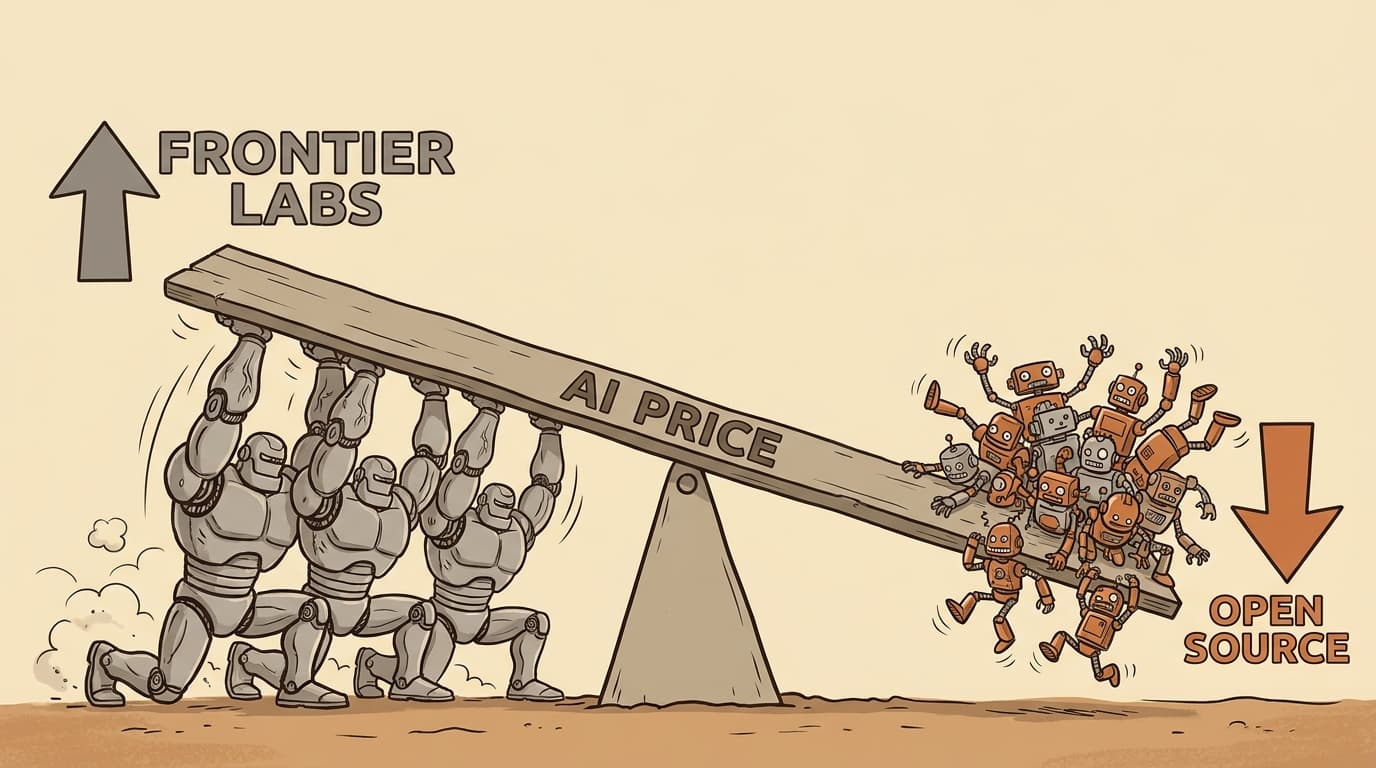
Will we pay more or less for AI in the future?
No big thesis this week, just a curated snapshot of the stuff that actually made me stop scrolling.