
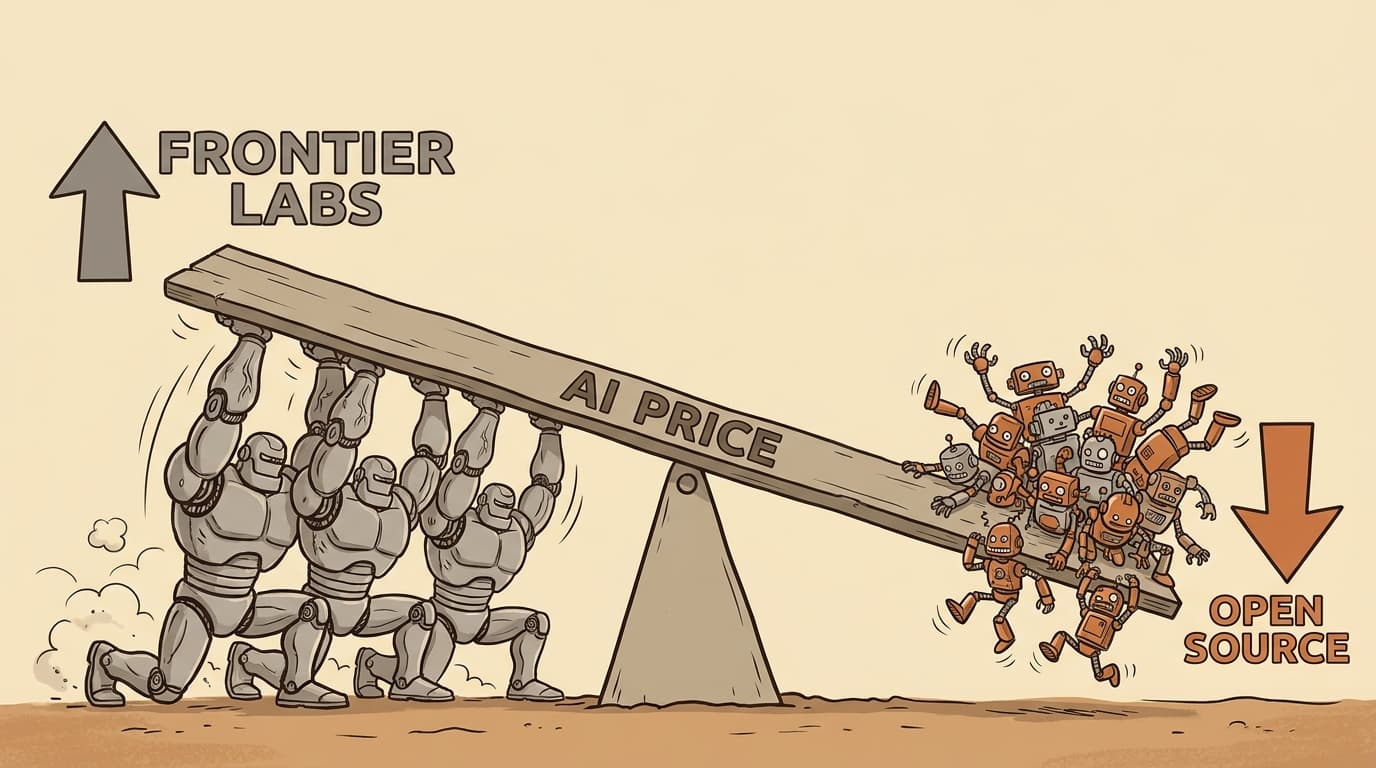
Will we pay more or less for AI in the future?
No big thesis this week, just a curated snapshot of the stuff that actually made me stop scrolling.
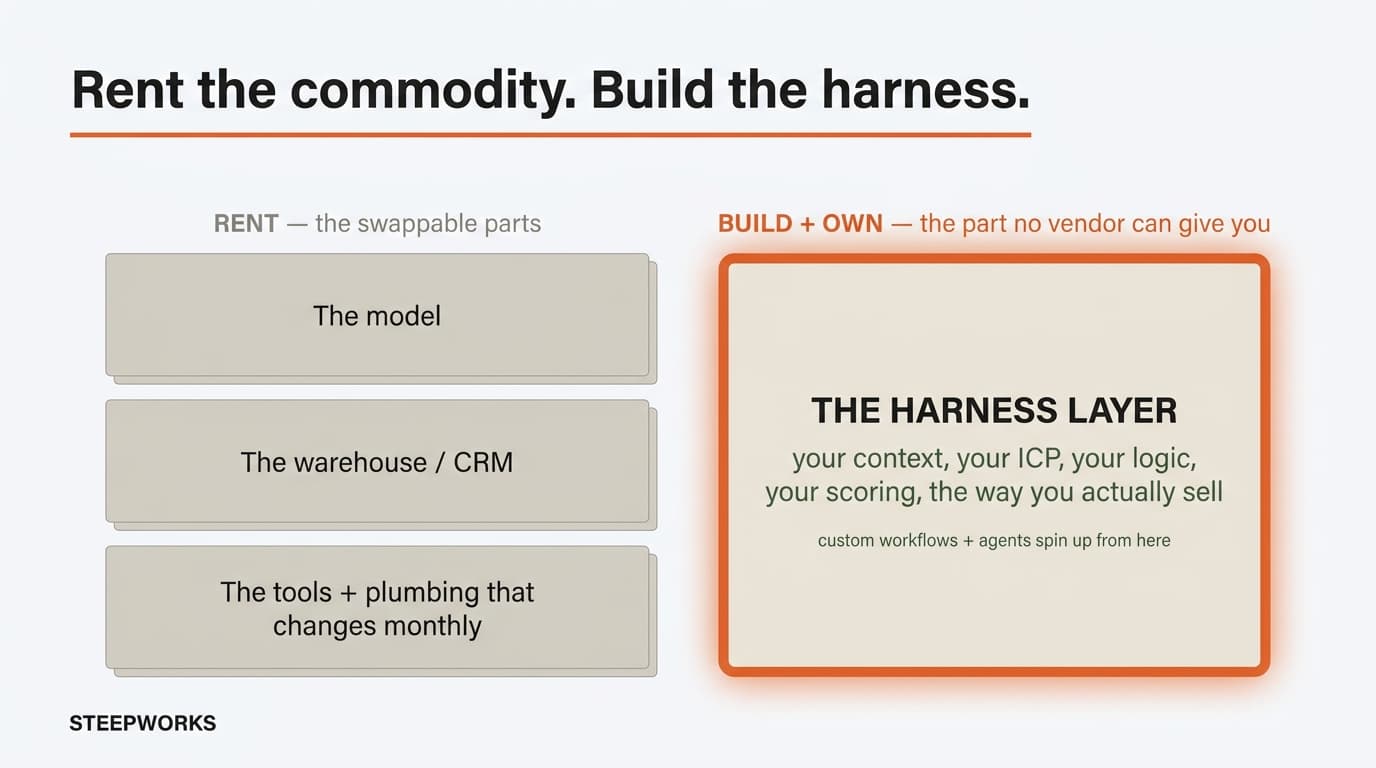
Most of what I read this week kept landing on the same old operator question: build or buy. The consensus answer that's emerging from practitioners right now is build the application, buy the infrastructure. In other words, rent the model, rent the warehouse/CRM, sequence tools and so on but build the harness layer.
Meaning your business knowledge (context) like your ICP, your product, your customer base, your market, your existing systems, the way you actually sell should be available in a way that allows you to then spin up custom workflows/agents against them without having to buy the solution.
What's interesting here is the different approaches to building that org-wide harness and how different some fundamental assumptions on that can be (more below).
Two companies are running sales orgs on AI they built themselves
The Signal got the internals of "ChatGTM," the AI Cursor's 400+ sales team runs on (Swyx has the deployment detail). It seems to work (although of course a great viral product doesn't hurt). Using the system:
- SDRs book 3x more qualified meetings
- AE ramp dropped 50%+.
What's really surprising about this build is that it doesn't pre-load markdown context files (or a more sophisticated context repo) at all. Every workflow, call etc. hits the live sources on demand via CLI or MCP. So when a rep asks, it queries Salesforce, Gong, the warehouse, the open web and pulls what it needs. That left me curious about how efficient that is and how they capture nuance for a given interaction — my one assumption being that skills do have context wired in and managed centrally. Anyway, the ChatGTM build runs against the whole way I've built my own operation, where you assemble the source of truth up front and structure it so the AI can actually use it. Their way is undoubtedly simpler upfront and has less markdown document maintenance but I'm left wondering at what cost.
Another example this week came from the company Profound, who built the same kind of thing. Their GTM engineer Edgar Sze wrote the most explicit "buy infrastructure, build application" call-out I've seen. "Buying almost always beats building," he says, and Profound was the exception because it needed their own analytics and their own definitions of how they sell, which no vendor has.
His staff engineer stood up v0 in under a week. Two months later it writes the briefs, scores every deal on MEDDPICC, and recomputes account health across the book. And the reason it had to be built: "Those definitions are the product."
(This reminds me of what Zach and his CoFounder Julian Tempelsman are building and why they believe intelligence is different — and greater — than memory.)
Lean manufacturing meets AI in Logistics
Saw an interesting interview of Dave Bozeman, the CEO of C.H. Robinson, around their AI strategy. At its core it's about using lean manufacturing principles as the philosophy that powers their AI transformation.
Lean manufacturing is a hundred years of one idea: map every step of a process, find the waste and the friction, cut it, measure, repeat. It's the discipline behind Toyota's production system and every factory floor that got faster without getting bigger. Put that way, it's kind of an obvious framework for AI. You don't buy the tech and go hunting for a use case. You map a workflow, find the step that's slow or expensive, and drop an agent on exactly that.
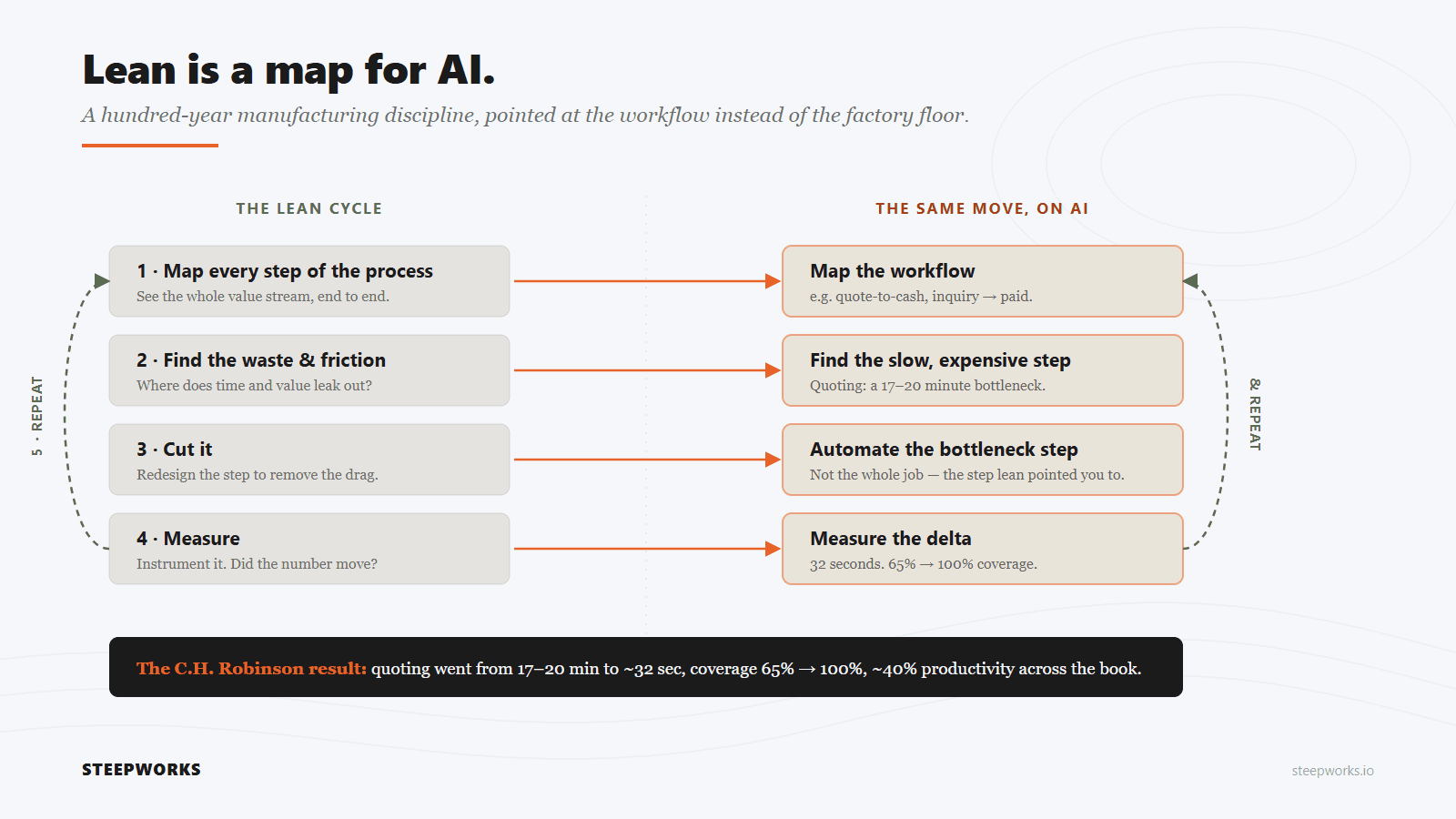
As one example, they mapped the quote-to-cash system (the path from a customer inquiry to getting paid) and found the quoting step was a bottleneck taking somewhere between 17-20 minutes. Their deployed agent took that to about 32 seconds, and coverage went from ~65% of inquiries to 100%.
It's their own newsroom telling the story, so take the halo with salt. What's interesting here is (a) how much instrumentation and data helps point you to where to focus and (b) that the hardest part might just be mapping where to start.
The compute-cost gap across orgs and models
The spread is nuts. Anthropic spends 2.3x its payroll on compute, roughly $2M of inference per employee. The top 1% of companies spend $89k per engineer per year on AI. The median spends $137 (about $13 a month). To which I say "what?"
But is it working? Spoke to a company that spent over a million euros on Claude last year. CEO wants proof its doing anything other than "we feel good about it." She's not alone.
The twist is that the bill and the usage have come unglued from each other. Brian Armstrong posted Coinbase's AI spend against token usage showing usage climbing to an all-time high while the bill drops toward half its peak. He didn't do it with spend alerts or usage caps. He did it with routing.
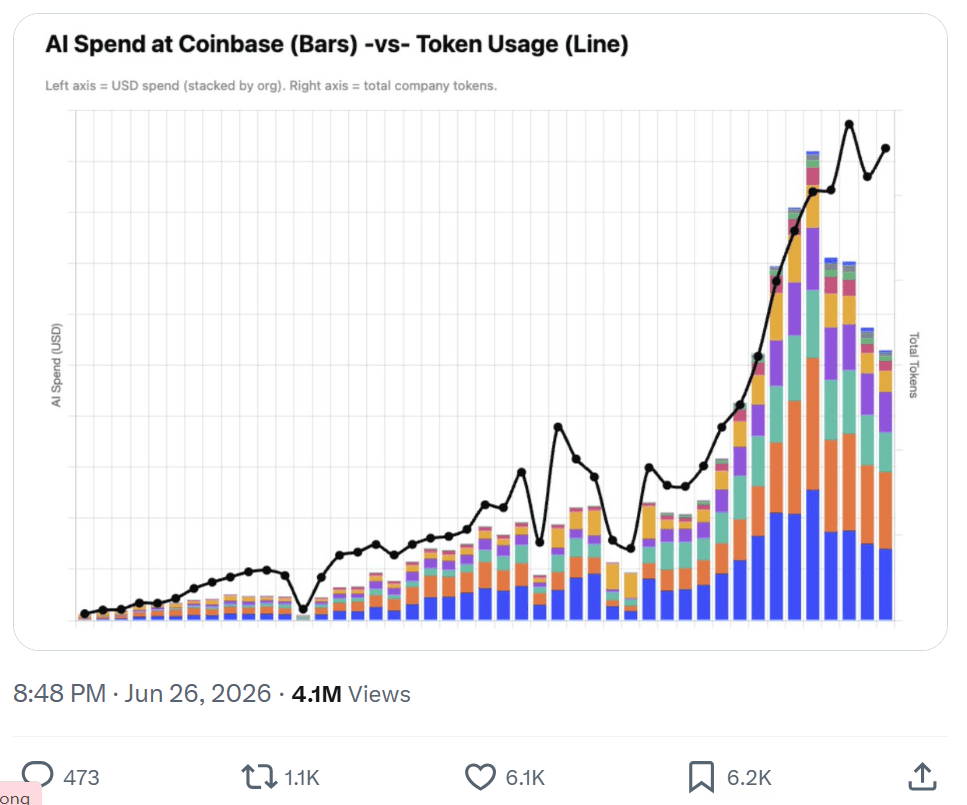
Routers are going to have a moment and frontier vs. open source is going to be talked about more and more and more in the coming weeks and months.
Quick examples of that: Claire Vo's $4.40 GLM-5.2 run against Opus at $25 and Theo's already splitting work across models rather than betting on one. When the routing is good the numbers get silly: HappyFox closed $1M in expansion on under $20 of tokens. "The thing worth owning is not the model," Armstrong wrote. "It is the router that decides, job by job, when it's worth paying up."
Your model has a worldview
The Economist ran 25 frontier models through the World Values Survey, the questionnaire that's mapped human moral beliefs across 100 countries since 1981. They plotted every model on the same two axes the survey uses for people: traditional-versus-secular and survival-versus-self-expression. Almost all of them clustered in one corner, secular and individualist, which is roughly the worldview of an educated Westerner, which tracks when 46% of the training-data crawl is English.
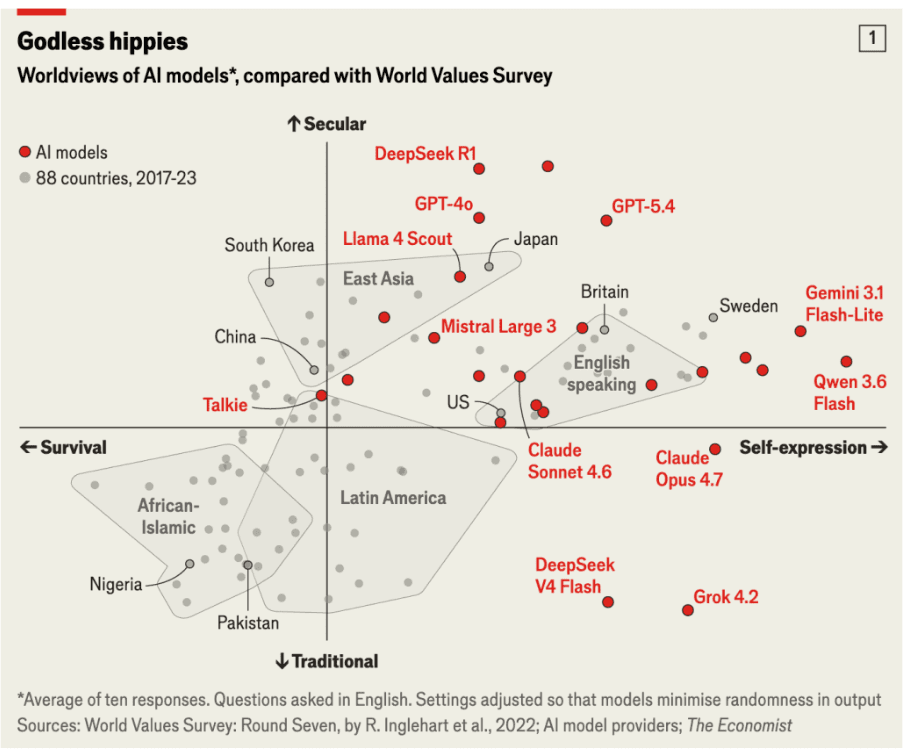
GPT-4o and DeepSeek R1 land as near-twins, one trained in San Francisco and one in Hangzhou, while DeepSeek's own two models sit at opposite ends of the map. Geography isn't destiny here.
Gusto's CTO went back to writing code and shipped a product in 10 weeks
Eddie Kim runs a $1B company and went back to being an IC. Four engineers, one designer, a net-new product from zero to a tier-one launch in ten weeks, with no Figma, no Jira, no docs. His "trash-can method," write a full PR as a way to make a product decision, then delete it, is an interesting real example of how traditional product management workflows are being upended.
Zoom is buying Common Room, woah
Zoom is acquiring Common Room, the AI-native buyer-intelligence platform (terms undisclosed, closing within weeks). Common Room does signal-based selling, the dark-funnel signals from community and developer channels, and its customer list has Anthropic, Atlassian, Notion, Snowflake and others.
Common Room was the scrappy ~20%-of-ZoomInfo-cost alternative and now it belongs to your voice platform? Zoom already sits on the closest thing most companies have to customer truth: every sales call and meeting, recorded, transcribed, and already in the workflow. Bolt buyer signals on top and it feels like they are trying to build the data layer an agent would run a whole revenue org from. Zoom is closer to that than most people give a video company credit for.
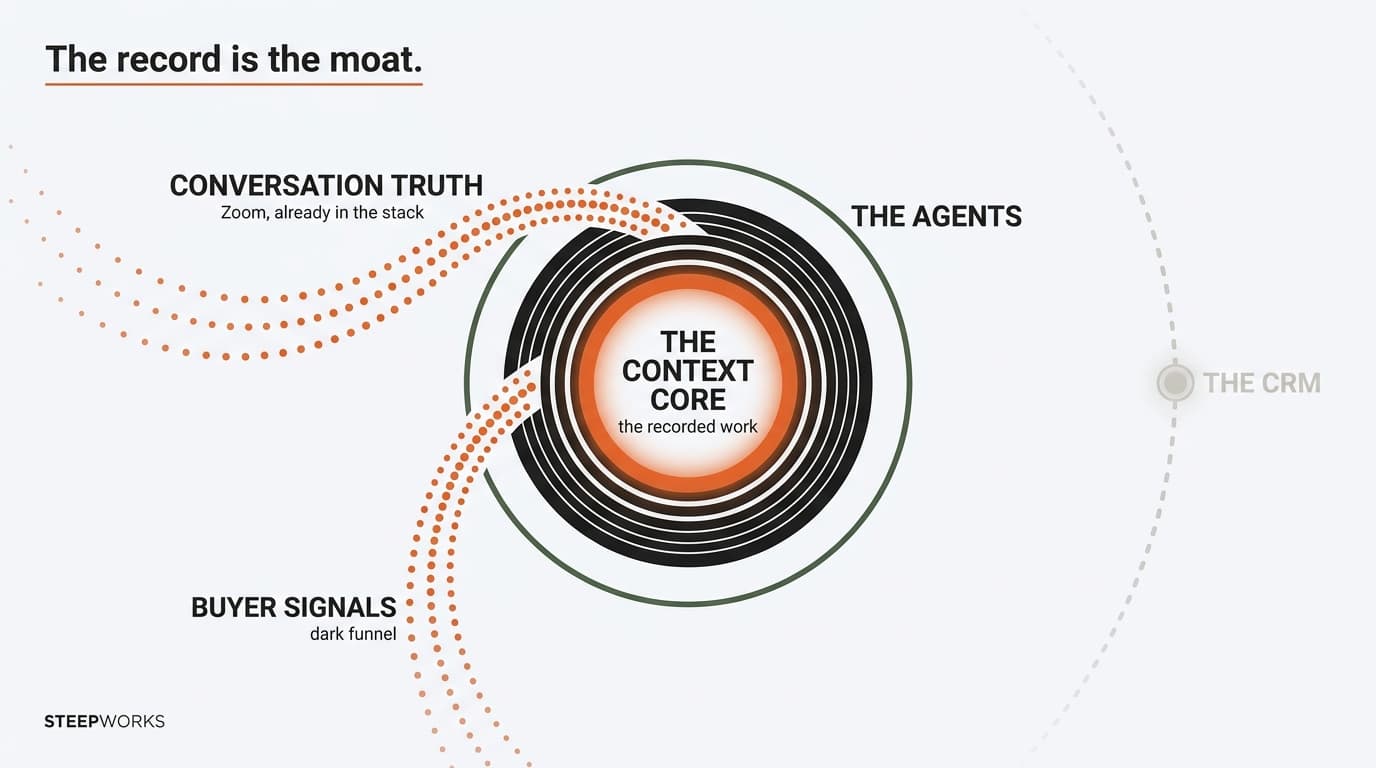
Thing I find interesting is where else Zoom is going to acquire. GTM is one use case, but I wonder about internal ops workflows too from that same conversational layer.
The agents are merging, not multiplying
Everyone sold you a future of 100 specialized agents. SaaStr says that's not what's happening: their AI VP of Finance didn't get its own app, it moved in with the AI VP of Marketing and started sharing context. They wired Bill.com, QuickBooks, Brex, and PandaDoc into one agent, and contract-close-to-invoice went from a day to 30 seconds. Fewer agents sharing context beat a swarm of narrow ones.
Someone's agent deleted their entire project from an ambiguous prompt
The reality check under all the "let the agents build" energy: a Claude Code user watched it recursively wipe his Electron project root on Windows. His prompt never said delete, wipe, reset, or remove anything. It ran Remove-Item -Recurse -Force on its own because it half-understood a sentence in Traditional Chinese. Money burns the same way: someone else torched $6,000 of usage overnight with one command. Cap your loops and put a verifier in front of anything with delete or spend permissions.
One for the weekend: how the first draft decides the last one
Stanford's "primal mark" research is about the very first move you make on a creative task, the initial sketch or seed you put down before you've refined anything. Their finding: that first mark anchors where the idea can end up. Start from something familiar and you get useful-but-not-novel; start from something new and you get novel-but-not-useful. The best results come from an integrative primal mark that fuses the familiar and the new, though people rarely reach for it because it's the harder cognitive move.
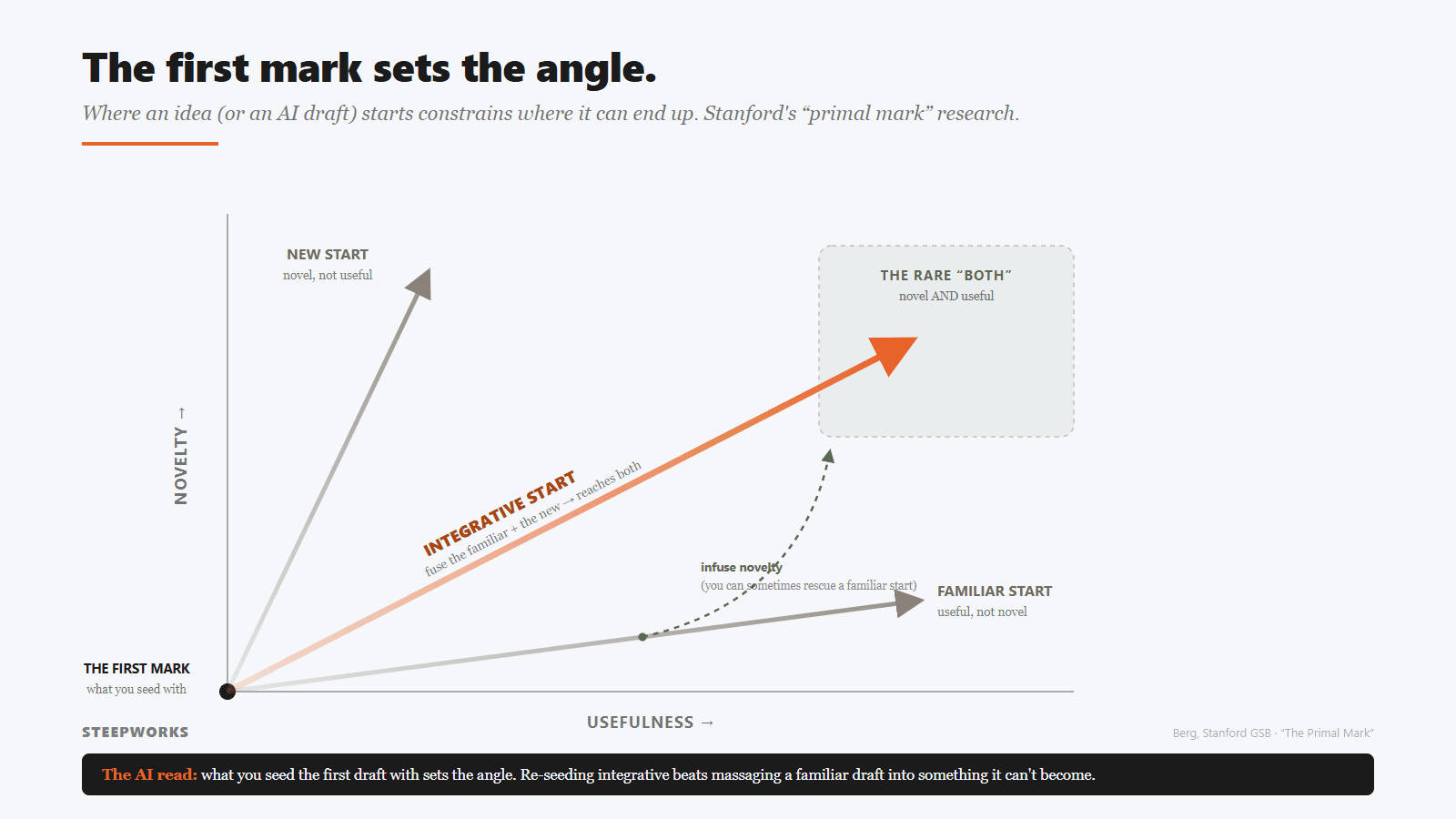
Which is the academic version of why what you seed an AI first draft with matters more than the prompt that polishes it (and maybe why you should blow up bad deliverables and just start over instead of trying to massage it into something worthwhile).
More worth your click
Models and money
- A government order pulled two frontier models off the shelf for a week. — Anthropic had to block foreign nationals from Fable and Mythos in mid-June, then pulled both for all customers until Commerce signed off. Fortune called it a licensing regime by another name. And the entanglement is only deepening: OpenAI just floated handing the US government a 5% equity stake, which one Forrester analyst warned will push other jurisdictions to demand the same and force European and APAC buyers to re-examine every "neutral American provider" assumption they've been making.
- Fable 5 shipped at roughly double the price of Opus 4.8. — $10 in, $50 out per million. The frontier got pricier the same month open weights got good enough, which is exactly why the routing question is live.
Sales and GTM
- The Salesloft–Clari merger is seven months in and still two products. — Separate interfaces, no unified roadmap, pricing drifting up for the bundle. If your renewal's coming up, that's leverage.
- Databricks says the dashboard is dead. — A car maker put 70,000 non-technical people on plain-language queries with no analyst in the loop. Take the vendor framing with salt.
- Same tool, opposite results: Spain +118%, the UK flat. — A GTM leader watched two regions run the identical digital-sales-room play to completely different numbers. People still matter folks.
- Proprietary data is the one AI citation you can't be routed around. — Kevin Indig on getting cited by LLMs: publish a number that's a byproduct of your business, not a survey you bought to fill a content calendar.
Building and running agents
- "WTF Is a Loop? Part 2" — — mvanhorn pulled the fifteen loops people actually run and rewrote each as a command you can paste tonight. Get the distinction right first: /goal runs until a condition is true then stops, /loop repeats on a timer, /schedule runs while your laptop's closed.
- The new shape of product work. — OpenAI's Codex lead on taste as the scarce skill and roles collapsing into each other. Echoes the Gusto build story.
- 2,000 people tried to break Simon Willison's AI assistant and nobody got in. — 6,000 failed prompt-injection attempts against Opus 4.6. He still won't ship a system where a breach does irreversible damage though.
The human still in the loop
- "I was wrong about Claude." — The guy with 20M views on his Cowork setup guides says stop using them, the single-player config falls apart the moment a team of hundreds shares context.
- Whoever decides the tagline is responsible for how it performs. — Joe Hudson's line, reshared by Lenny. Run it through an org where half the "who" is an agent, and accountability still stays with the person who shipped the loop.

Get the verdict.
The AI x GTM briefing for operators, about every 10 days. Free forever.
A deep dive about every 10 days. Unsubscribe anytime. No spam, ever.
More Issues

How much AI should one employee cost?
What Rippling, IKEA, DeepSeek, and NVIDIA show about AI spend, work ownership, job redesign, and model efficiency.