You adopted AI. Did the judgment come with it?
AI adoption isn't slow, it's jagged — and the jaggedness is producing new friction: speed against accountability, the entry rung getting cut, and the question of where judgment comes from next.
By Victor Sowers — 15 years scaling B2B SaaS GTM
The Signal
The Shift
The story everyone tells about AI adoption is a speed story. Some are early, most are new or haven't begun. Eventually the gap will close as the laggards catch up.
My friend and former co-founder Parker Ferguson calls the gap between the people getting outsized value from AI and the people getting nothing one of the most consequential of our time.
He's right, but I don't think that's actually the most interesting story right now. What's more interesting is how the distribution of adoption is creating new jagged edges and friction points and modes of working within organizations.
We're seeing that play out in all kinds of ways including:
- Speed against accountability
- Experimental deployments vs. real ROI (and bottoms up vs. top down initiatives)
- Org charts built for people against agents built for tokens
- Corporate incentives against employee ones
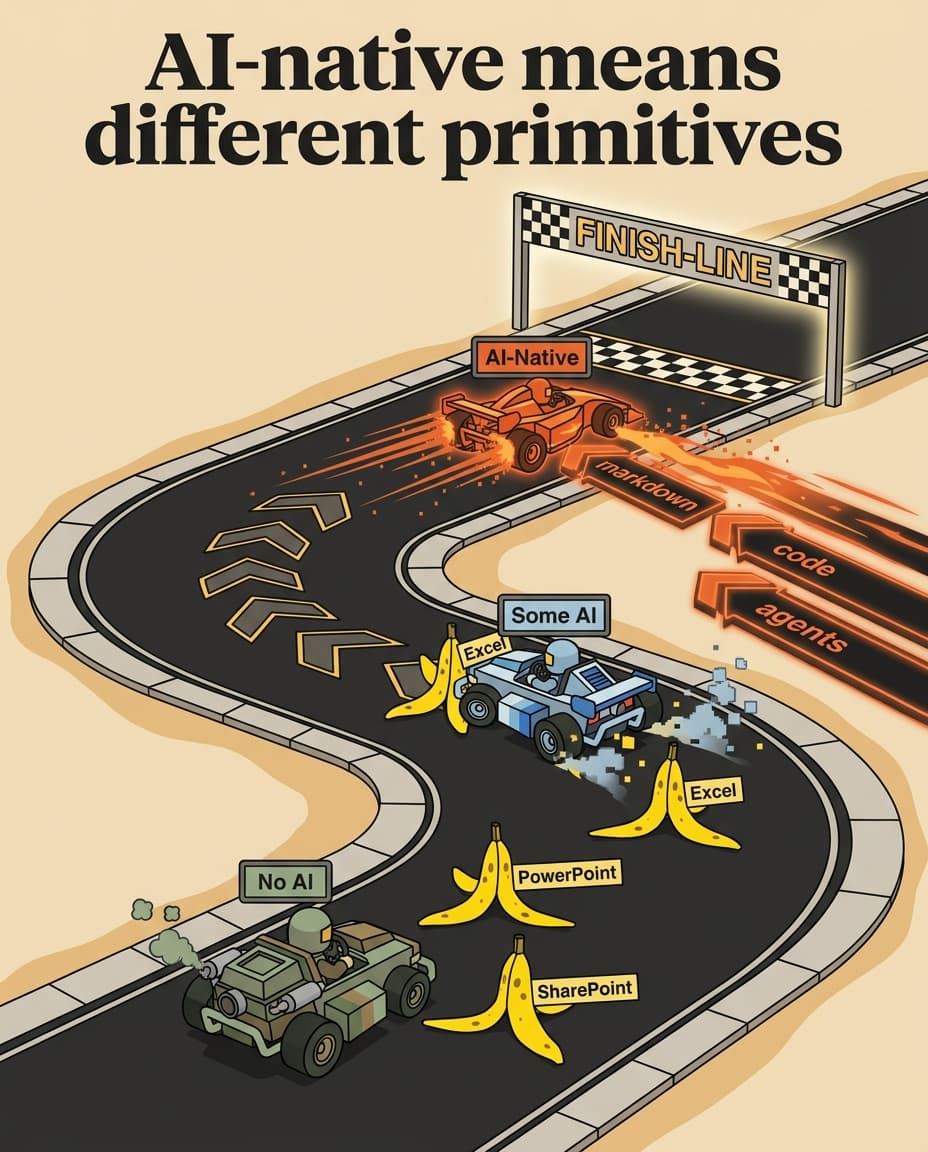
- Old file types and primitives against new ones
And under all of it, the question of what's reality and what is hype.
This week I'm most focused on the speed vs. accountability question and the friction points in collaboration across the adoption distribution curve.
We'll also touch the week's news including Anthropic's Opus 4.8, Pope Leo's *Magnifica Humanitas*, and returning to the labor/capital/youth job-market dynamics that anchor the societal dynamics and political realities around the tech.
Speed vs. accountability — why individual gains don't add up to team gains
Key takeaway: The human is still responsible for every facet of the delivery. Period.
The collision: speed vs. accountability. AI makes individuals dramatically faster. It probably doesn't reduce the work-load. And the org-level gain from doing more faster keeps not showing up in ROI numbers.
I run my whole operation on AI and I do more varied work and am faster at almost everything than I was a year ago. So are a lot of you. And yet the team-level, org-level return on that speed is far murkier (data below).
A lot of that is because coordination is bottlenecked — both between agents but more interestingly between the people responsible for the work. As I see it there are two primary sources for that bottleneck. The first is integrating AI native workflows with more "traditional" workflows. That shows up as working with different primitives and uneven review/turnaround speeds.
The second component is ensuring that the work product retains human accountability and judgment.
IBM famously said: "A computer can never be held accountable, therefore a computer must never make a management decision."
Today though in both individual and team-level workflows human accountability is far from a given. Interestingly it may well get harder as models get better.
I had an interesting experience with this recently where I'd written a PRD for a landing page that had draft copy, visual elements, sections, styling call-outs and more. It was robust. But it was not complete. I had not mocked it up in HTML, spent hours fine-combing every line and every style and layout choice. That was the job I was handing off to someone with more talent and experience in that space.
What came back was a finished landing page specced exactly to the PRD. It wasn't wrong exactly. The copy was serviceable and the layout was clean. What was missing was the hundred small calls about emphasis and structure and which capability claims were actually true enough to put in front of a customer. The expertise required was in the finish, and in this case the finish never happened.
By the way, this isn't about people being lazy either. Iterable's 2026 Customer Engagement Report found that 40% of marketers report *more* work since adopting AI.
In the end the model can draft the thing, ship the thing, even be right about the thing. It still can't own the thing. When the output is wrong, nobody points at the model. They point at you.
I think the accountability needs + work-product translation + the actual jagged edge of AI capabilities helps explain the panic over ROI when enterprises adopt AI. And that panic really took off this week.
- Derek Thompson called it the "wait, is this worth it?" phase
- Gary Marcus has been cataloging the companies admitting it.
Of those, Uber is the loudest recent example. It put AI coding assistants in front of 5,000 engineers in December and burned its entire 2026 AI budget by April, about $3.4B in tokens at $2,000 per engineer per month. Worse, the COO admits he can't tie the spend to meaningful ROI.
Part of this is the bottleneck at review we talked about (e.g. Wikipedia/public repos drowning in AI commits). The 2025 HBR "workslop" study summarized it well: AI-padded work just "transfers the effort from creator to receiver," and leads the receivers of that work to regard their colleagues as LESS reliable and less trustworthy. It's tempting to chalk this up to AI-pilled super humans getting slowed down by slower adopters. This is NOT that story. AI is wonderful *around* a decision (gathering, drafting, routing, summarizing, producing) and dangerous *as* the decision or final pass. Yikes!
New accountability mechanisms and stated/unstated cultural norms need to surround AI-enabled work. The simplest — and for now most practical — way to start is that the human is still responsible for every facet of the delivery. Period.
If machines get better than us, where does judgment come from?
AI is cutting the entry rung — the exact place judgment used to get built. The collision: corporate incentives vs. employee ones — cut headcount now, against the org's need to keep producing the seniors it'll need later.
Back in April I wrote "The money moved. The jobs didn't follow". It basically told the story of the jobs market as AI capex climbing while hiring wasn't.
This month showed more stories around this macro story.
- Oliver Wyman's CEO survey found the share of executives planning to cut junior roles doubled from 17% to 43% in a year, with hiring tilting toward older workers.
- Tomasz Tunguz said on the GTMnow podcast that SDR and BDR automation is a one-way change. The first rung of three different GTM functions is going at once.
- One recent study pushed back on "the story is AI taking jobs" narrative. The study found 63% of the uptick in youth unemployment might trace back to COVID and remote work. It's hard to train someone new, and harder when you're never in the same room. So some of what looks like AI eating the entry rung is really a hangover from how we reorganized work five years ago.
But the trend is undeniable. In addition to the human and social story today (the most important part), it's also an entry into arguably the most important philosophical questions of our time.
How do we train and develop people if machines are better at stuff than us? What happens if we don't? Will we have people with great judgment in 5 years? 10?
Deloitte for example, flagged a "missing middle" where AI adoption actually *declines* with age. So the senior people who'd model good judgment are often the ones using AI least, while the juniors who'd learn it are getting automated before they start.
It's also not like more AI by default reduces work or the need for humans, despite the CEO mania around efficiency. After all, if automation just deleted work, the most AI-aggressive companies would be the smallest. They're not.
Every, an AI-focused media company/incubator, for example, tried to automate everything it could with Codex and Claude Code, then doubled headcount from 15 to 30. Dan Shipper, Every's CEO, put it well when he said making expert work cheaper does not simply replace experts.
The Stack
- Repo of the Week: anthropics/knowledge-work-plugins — Anthropic's open collection of Claude plugins for non-engineering knowledge work: each one bundles a set of skills (a prompt + instructions + sometimes a script) you drop into Claude so it does a job the same way every time instead of improvising. It's the installable cousin of the small-business skills that did ~382K downloads on day one. What I'd actually do with it: don't install the bundle and call it done — that's the adoption-not-transfer trap in miniature. Open two or three plugins, read the skill files, and steal the structure (how they scope a task, where they force a checkpoint) for your own repo. The plugins are good scaffolding; the judgment about which steps matter for your work is the part that was never going to come in the download. Read more →
- How-To of the Week: Anti-Slop — 15 Patterns I Check Before Any AI Content Ships — If this issue is about owning the output, this is the checklist version. The 15 patterns are the audit step the abdication failure skips. It's content-specific, but the principle ports: name the moment where "is this actually right, by someone who'd own it?" is somebody's job. Read more →
Reading Corner
- [Podcast] A rational conversation on where AI is actually going — Benedict Evans — The deep read this week. Evans makes the case that this is a 1997-internet moment, not a 2000-bubble one, and that most of the job-loss takes are wrong in both directions. He's not a hype guy, which is why the measured version of "this is real but slower and weirder than you think" is worth an hour of your commute. Useful corrective if the ROI-panic crowd has you too bearish.
- [Thread] The operating loop, not the one-shot prompt — Jason Liu — jxnl's framing that the unit of work has stopped being "one prompt, one answer" and become a durable loop with a human steward who reviews artifacts. Read it as the how-to underneath this whole issue: the steward is the framer, operationalized.
- [Blog] The AI backlash is growing faster than AI revenues — Exponential View — Anthropic is set to turn a profit this quarter, two years early, and the backlash is outrunning even that. My read: the backlash isn't anti-AI, it's anti-abdication. People resent output no human will stand behind.
- [Data] The AI adoption gap, by generation — JPMorgan Chase Institute — The board-meeting number from this issue. Across JPMorgan's small-business customers, younger owners use AI for the judgment-heavy work (pricing, copy, customer comms) and show faster revenue growth and steadier employment than low-adoption peers of the same size. The uncomfortable read: AI leverage isn't tracking seniority. Your best "framer" might be your most junior operator.
- [Take] The AI Adoption Gap is growing — GAI Insights — A clean articulation of why "we're piloting AI" is a trap: model capability compounds quarterly, but enterprise decisions move on annual cycles, so the gap widens while everyone feels busy. Nobody owns closing it, which is why it stays open.
- [Essay] How to enter side doors — Velvet Noise — On getting in through the unguarded entrance instead of the front door everyone's queued at. A good companion to the "your best framer might be your most junior operator" idea — leverage doesn't come from where you'd expect.
- [Guide] The AI SEO Playbook — STEEPWORKS — Our own gated guide on getting found in the answer economy. If this issue is about owning the work, this is about owning the channel where buyers now actually look.
- [Fun] Your AI Slop Bores Me — Exactly what it sounds like, and a fitting closer for an issue this preoccupied with the difference between output and judgment.
Tool Watch
- Claude Opus 4.8 shipped — A drop-in over 4.7 at the same $5/$25 per million tokens. Effort control (pick how hard it thinks, low through max), fast mode 3× cheaper, a stronger honesty bias, and roughly 4× fewer code flaws slipping through unremarked. The cost of a unit of trustworthy output just dropped while the price held flat. "The model isn't good enough yet" is getting harder to say with a straight face. (source)
- Perplexity shipped Computer — Research, code, deploy, and manage a project end-to-end from one conversation, orchestrating 19 models in parallel, with a Mac version that edits local files and drives the Comet browser. Useful, and a little unnerving: the more an agent acts directly on your machine, the less abstract "who owns it when it's wrong" gets. (source)
- Dropbox hit $1B ARR faster than any B2B company ever — and is calling it the end of an era — The cleanest PLG story of the last decade winding down. Worth watching what becomes the default motion when the product can no longer sell itself. (source)
One Thing I'm Thinking About
Grappling with these questions is going to matter more and more. In part because if AI is creating this much value, who actually captures it?
So far the honest answer is "not labor." Worker pay just hit its lowest share of national income on record at the same time corporate profits are taking the biggest slice since the early 1950s.
*Data: U.S. Bureau of Economic Analysis. Chart: Matt Phillips / Axios.*
Get the verdict every Wednesday.
The AI x GTM briefing for operators. Free forever.
One email per week. Unsubscribe anytime. No spam, ever.
More Issues
AI's so smart it needs teams to deploy it.
The rise of Forward Deployed Engineers, the AI image problem, and the end of cheap tokens.

Everybody's building. What aren't they asking?
The AI wave is exciting and unsettling at the same time. Unemployment for recent grads hit 5.6% — worst in 37 years. Meanwhile Anthropic went from $9B to $19B ARR in 90 days. The build momentum is real. So are the costs nobody modeled: maintenance economics, token subsidies with expiration dates, and the apprenticeship disappearing underneath us.