
Nadella says human and token capital compound. Your org chart disagrees.
Satya says human and token capital compound. He doesn't say which humans. Your most senior people might be the ones the AI era selects against.
The Shift
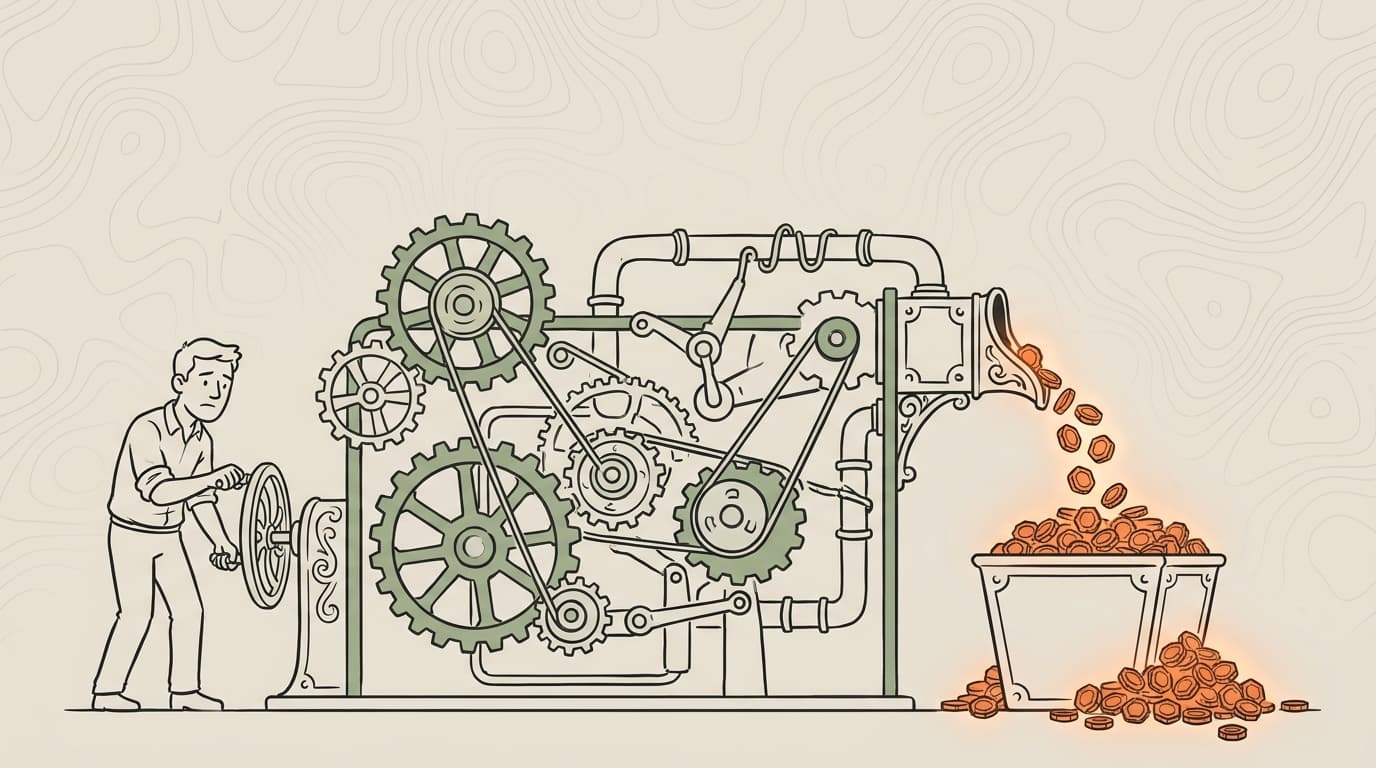
Satya Nadella laid out a vision this week of how AI and human collaboration unfolds inside a company, now and in the future. His take is that every company now has to build two kinds of capital. Human capital which consists of the judgment and taste and relationships of your people, and token capital which is the AI capability you build and own, your evals, and traces and the institutional memory you can query. It's a bit of a mix of compute + memory.
Satya's theory is that these two types of capital can compound, and specifically that human capital gets more valuable, not less in this world, both because of the unique value of taste + relationships and also because the work great people do can now be stored as artifacts that help the company and its AI harness get better over time.
I then read a reaction in the Turing Post, Ksenia Se's AI research newsletter, which added an interesting wrinkle. Ksenia calls out that human capital within companies suffers from incentive distortions. The political incentive structures inside a big org - who gets promoted, whose proposal survives the room, what gets signed off - reward a different thing than the high-quality outputs that would actually feed the compounding loop Satya envisions.
(There is of course also a senior/junior and ageism split here that we should be careful to not correlate).
More below.
The Roundup
- Report — "Revenge of the AI bubble" — the spend propping up GDP growth is the same spend whose ROI nobody's measured. Read it next to the measured productivity gain from AI so far, about 7.8%, not 10x, and decide which one you believe. (Axios)
- Article — What 6 verticals agreed was the actual moat at SaaStr AI Annual: the model commoditized; the consensus moat was proprietary data and workflow. That's token capital by another name. (SaaStr)
- Data — In 2026, fewer than 1/3 of Google searches still send a click. If your GTM still assumes the click, the loop you should be building isn't the one you're funding. (SparkToro)
- Thread · social — "Our AI bills are subsidised and nobody priced it in." Worth reading before you model token capital as a durable cost. (r/artificial)
- News — This founder isn't hiring junior engineers anymore — the clearest field evidence of the bench contradiction: the rung that used to grow your future loop-builders is the one being cut first. (Platformer)
Visual of the Week
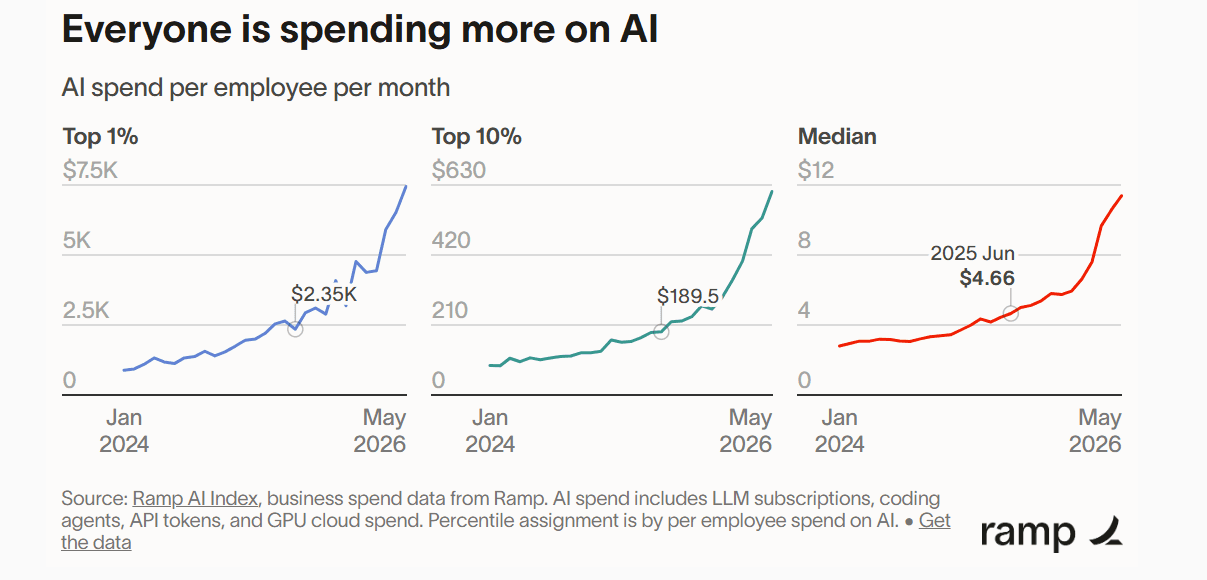
Your best people might be wasting your token capital
Key takeaway: The org incentives that made your best people senior are not the ones that feed the compounding loop. Which human capital is the real question.
Let's cover the compounding token loop mechanism a bit more. In some ways it feels like a tale of two very different ecosystems.
Much of my recent direct experience is in consulting and advising early stage companies + running growth at one. In this context the coordination overhead is low, and AI-pilled speed has eroded the manpower advantage of larger firms. Layer on top lower barriers to entry via lesser security concerns and an appetite for experimentation and its fertile ground for compounding loops.
Nadella calls this a hill-climbing machine in that every workflow you fix becomes a better training signal, eventually compounding into firm IP. By the way, part of the reason I agree with this is that in these fast iteration loops the people who know the work are doing the work and are understanding the edges of current AI tooling. There is no other way.
This is very different than work by committee and delegation that defines many big orgs. Ksenia Se puts it well:
> If you are a star at Microsoft, inside that particular corporate structure, you are limited by so many things. Incentives. Committees. Procurement logic. Internal kingdoms. The need to sound correct before you know what is true.
It's a feel-good, don't-rock-the-boat gravity that is a type of parallel institutional anchor on effectively unlocking token capital (and might be part of the low ROI on AI adoption that we covered a couple of weeks ago). Still, at some point, unevenly or not, we're going to arrive at a place where companies lock in the institutional memory of their best performers before they walk out the door.
That moment is either going to be awesome or horrible for humans and no one knows which it will be yet.
You don't own the loop if someone else owns the off switch
Key takeaway: Owning your loop — private evals, traces, queryable institutional memory — is the only asset that survives a model seizure. The model is the part you should now assume you can lose.
Last Friday at 5:21PM, the Trump administration issued an export-control directive forcing Anthropic to suspend its newly-released Fable 5 and Mythos 5 models for "any foreign national," inside or outside the US, including Anthropic's own foreign-national employees. You can't separate a green-card holder in California from a citizen in real time, so Anthropic disabled the models for everyone, worldwide, three days after release. It was the first time US export controls hit an AI model itself, not the chips that run it.
This is the other side of the human and token capital story. If your senior people are building real loops, those loops are private evals, RL traces, and queryable institutional memory. That's the part you keep when the model gets pulled.
The firms renting raw model access lost everything overnight. The firms holding portable traces kept their company-veteran expertise and waited for the next model.
The off switch isn't always policy, either. This week's news that Elon Musk's SpaceX acquired Cursor for ~$60B, one of Anthropic's biggest customers, is the M&A version of the same risk.
I don't have this resolved. The loop is the only asset that survived this week. The model underneath it is something I now assume I can lose.
Take of the Week
“Taste is not something you can just download. It's earned through hard experience and a lot of failures.”
The whole token-capital conversation assumes the judgment that grades the loop is durable. Fadell says the opposite, that taste is the one input you can't buy or prompt into existence, and it only accrues from being wrong in public enough times.
Build Corner
Repo of the Week: yusufkaraaslan/Skill_Seekers (~13,000 stars)
Skill_Seekers turns any documentation into Claude skills automatically. You point it at a doc set and it generates the skill files: the prompt, the instructions, the structure that makes Claude do a job the same way every time. Most operators don't know it exists, which is exactly why it's worth a look this week.
It ties straight to the issue. This whole thing is about building and owning your compounding loop, and token capital is the institutional knowledge you capture and reuse, not the model you rent. A doc-to-skill converter is the buildable version of that. Your runbooks, playbooks, and onboarding docs become skills your agents can run.
What I'd actually do with it: point it at your messiest internal doc, the one that lives in three people's heads and one stale wiki page, and see what skill falls out. Read the generated files. They're rough, but they're the start of token capital you own, not something you procured.
Reading Corner
- [How-To] How to design AI agent loops: schedules, goals, and subagents in Claude Code — The literal how-to for the loop this whole issue is about. If the Nadella framing has you convinced the loop is the IP, this is the mechanics for actually wiring one up: schedules, goals, subagents.
- [Data] When Americans choose Chinese AI — DeepSeek runs at roughly 1/20th the cost and the developers quoted report no difference in output quality. This is the read that makes "own the loop, the model is rentable" concrete: if the model is a commodity you can swap, the durable asset is the loop wrapped around it.
- [Report] AI is masking America's post-literate workforce — Heavy automation erodes the judgment reserves your loop depends on, because a loop with a human steward is only as good as that human's ability to review the artifact. Pairs with the Fadell take in this issue: the skill you stop using is the skill you lose.
- [Take] Tomasz Tunguz, "Intelligence Per Dollar" — Reframes the cost question from tokens spent to tokens per result. Steal the metric: a senior person burning tokens on committee-fluency looks busy on spend and produces nothing per result, which is the cost-discipline leg under the whole token-capital argument.

Get the verdict.
The AI x GTM briefing for operators, about every 10 days. Free forever.
A deep dive about every 10 days. Unsubscribe anytime. No spam, ever.
More Issues

How much AI should one employee cost?
What Rippling, IKEA, DeepSeek, and NVIDIA show about AI spend, work ownership, job redesign, and model efficiency.