Three Newsletters, Three Pipelines, One Breaking Point
I was running three newsletters — two hyper-local family events brands and a B2B GTM intelligence weekly — as three completely separate operations. Three content pipelines, three template sets, three scheduling spreadsheets. The duplication was manageable until the DMV edition went out with Baltimore's header because I copy-pasted the wrong template block at 11 PM. That's when I realized email marketing automation, as every platform guide teaches it, stops at the boundary of a single brand.
The three brands serve different audiences with different voices on different schedules. Two local family events newsletters — one covering Baltimore, one covering the DC/DMV metro — use warm, community-oriented language and ship weekly on different days. A B2B weekly covering GTM intelligence uses a different structural layout entirely. Different audiences, different voices, different cadences. But the same operator, the same content pipeline upstream, and the same delivery platform downstream.
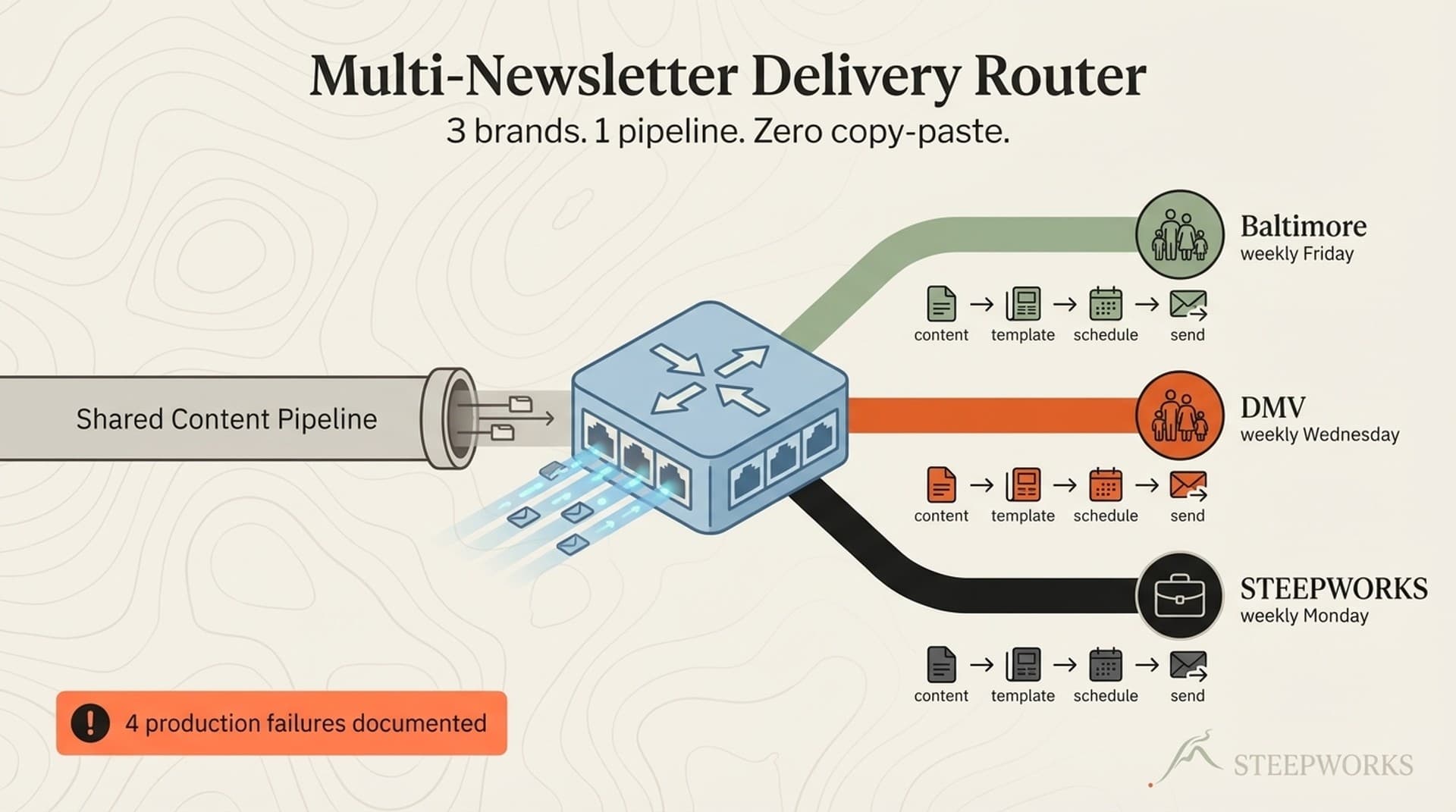
This is a buildlog of the delivery router I built to solve that problem — a shared infrastructure layer that sits between content production and email delivery, routing the right content to the right brand with the right template on the right schedule. It handles 3 brands today. The architecture would handle 10.
The scale isn't enterprise. Across all three brands, the subscriber base is in the low thousands. Weekly send cadence is 3+ newsletters per week. But the growth rate — the family events brands doubled subscribers in their first quarter — made duplication unsustainable. At 500 subscribers, copy-pasting templates is an annoyance. At 2,000+ with a fourth brand in planning, it's a structural liability.
If you run multiple product lines, regional editions, or audience segments that each need their own newsletter, this is the same problem. And the platform guides don't address it. Moosend's 2026 automation guide teaches you triggers and sequences inside one brand. MailerLite's automation walkthrough shows you how to build branching logic for one audience. Neither answers the question: what happens when you run three brands from shared operational resources?
The Architecture — From Content Pipeline to Subscriber Inbox
Stage 1: Content Ingestion and Classification
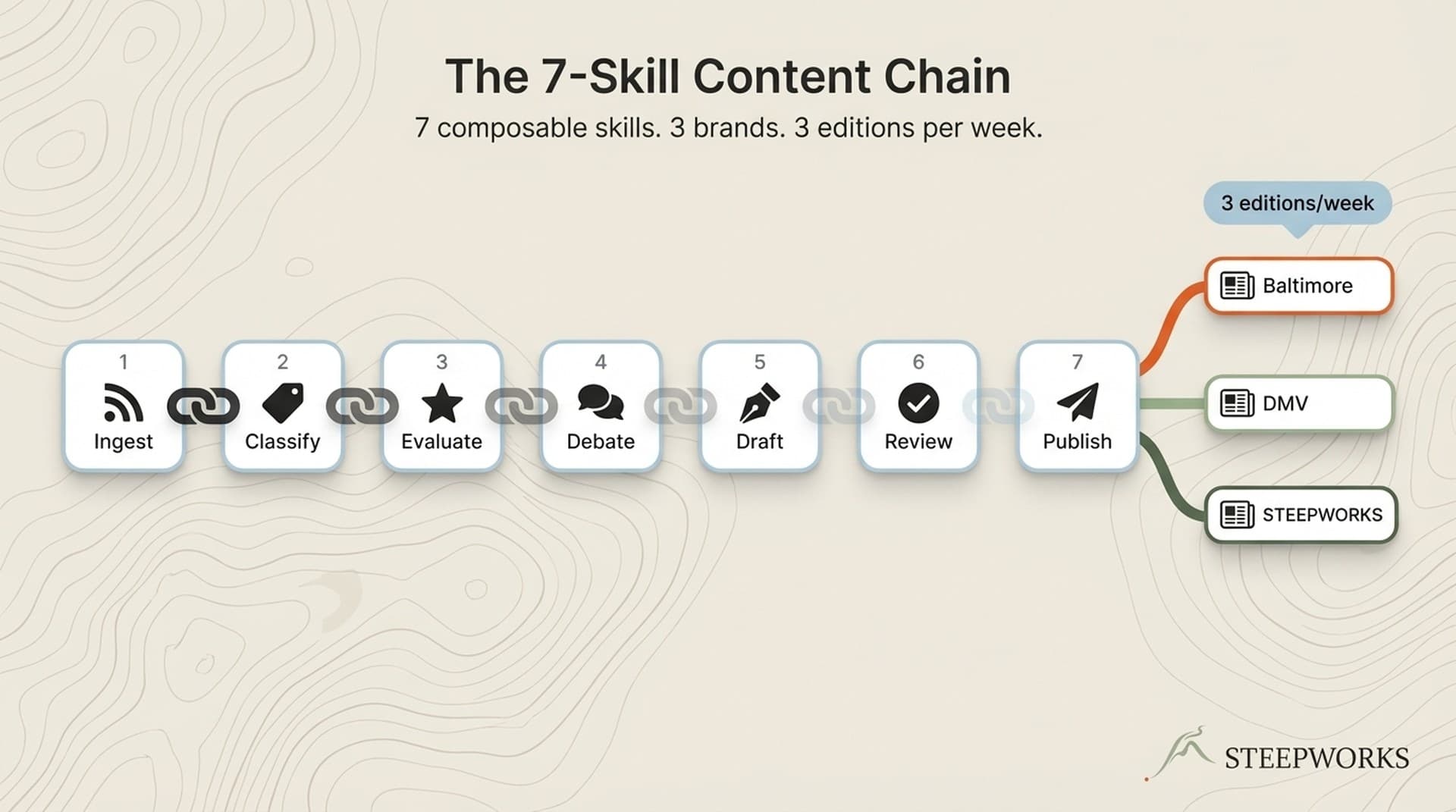
Content enters the pipeline from multiple sources: AI-curated event data from 313 scrapers and RSS feeds, human-written editorial content, and an upstream multi-agent evaluation system that scores articles through a 7-persona debate protocol. (I documented that evaluation layer in How 7 AI Agents Evaluate 120 Articles Weekly.)
Before content can be routed, it needs to be classified. A classification layer tags each piece with brand affinity, content type, urgency, and audience segment. This classification is what makes routing possible — content doesn't arrive pre-assigned to a brand. The router decides.
The infrastructure: Cloudflare Workers handle ingestion in a 5-phase pipeline — fetch, classify, store, export, notify. Each phase is an independent module that can fail without cascading. Supabase stores events with brand-agnostic metadata. Claude Haiku handles classification — deciding whether a "Spring Garden Festival" is Baltimore family content, DMV family content, or both.
The key design decision: classification happens upstream of routing. Content is brand-agnostic until the router assigns it. That means the same event can appear in both regional newsletters with different framing — or be routed exclusively to one brand based on geographic fit. A "Smithsonian Free Day" routes only to DMV. A "National Harbor Light Show" routes to DMV but gets a cross-reference mention in Baltimore for families willing to drive. Classification makes those decisions possible because it separates "what is this content?" from "who should see it?"
Stage 2: The Router — Brand Assignment and Scheduling
The router is the core architectural contribution. It takes classified content and makes three decisions: Which brand or brands should receive this content? What priority does it get within each brand's editorial queue? When should each brand's newsletter ship?
Routing rules aren't complicated in isolation — geographic affinity sends Baltimore events to the Baltimore brand, DMV events to the DMV brand, and GTM intelligence to the B2B weekly. The complexity emerges at the edges. Content that fits two brands gets assigned to the primary and cross-referenced in the secondary. Events with broad appeal (a national chain's STEM program launching in both metros) need deduplication logic so they don't appear identically in both editions.
Scheduling coordination is the most underestimated part of multi-brand email marketing automation. The family events brands share audience overlap — some subscribers receive both the Baltimore and DMV editions. Without coordination, your subscribers get two emails from two brands on the same Tuesday morning and unsubscribe from both. The scheduler checks for audience overlap before committing any send. It also respects per-brand cadence: the family events brands send on different days of the week, and the B2B weekly sends on its own day. Those constraints aren't hardcoded. They're configuration — which matters when you add brand number four.
Stage 3: Template Injection — Brand Voice in Infrastructure
Each brand has a template definition: header, footer, color palette, typography, voice guidelines, and structural layout. These are stored as configuration, not as separate template files per email.
When content gets assigned to a brand, the template engine wraps it in that brand's visual and editorial identity. Same content payload, different presentation layer. The DMV families header is not the Baltimore families header, and the B2B weekly has a completely different structural layout — two columns for newsletter picks versus a single-column event listing with age ranges and registration links.
Beyond visual templates, each brand carries voice parameters that shape how content gets presented. Sentence length, vocabulary constraints, tone markers. The family events brands use warm, community-oriented language: "This weekend, your little ones can..." The B2B weekly uses the Reflective Operator voice: direct, practitioner-framed, no hype. Voice isolation is enforced by infrastructure, not editorial discipline. Each brand maintains separate persona profiles that have evolved over months of production use, accumulating brand-specific learnings that diverge naturally.
Template injection sounds technical, but it solves a human problem: when you copy-paste between brands at 11 PM, voices bleed. When the infrastructure enforces brand boundaries, they can't.
Stage 4: Delivery — API-Driven, Per-Brand
Each brand delivers through the newsletter platform's API with separate sending domains, separate subscriber lists, and separate authentication records — SPF, DKIM, and DMARC configured per brand.
Why separate domains? Litmus documents the deliverability case for domain separation in multi-brand operations. Shared domains mean shared reputation. If one brand's spam complaints spike, every brand's deliverability suffers. Separate domains isolate the blast radius. One brand's deliverability problem doesn't contaminate the others.
Per-brand deliverability monitoring tracks open rates, bounce rates, and spam complaints independently. The family events brands consistently hit 50%+ open rates — hyper-local content for an engaged audience. The B2B weekly runs lower, typical for the category. Those metrics need to stay separate because the baselines are different. A 35% open rate is a problem for the family events brand and a strong result for the B2B weekly. Aggregating them would hide both signals.
The shared infrastructure is the pipeline, not the delivery identity. Each brand owns its own reputation with ISPs. That separation is non-negotiable. Mailtrap's infrastructure guide covers the full technical stack between "content is ready" and "subscriber sees it." The delivery router sits on top of that stack — it's the routing logic that decides which brand gets which content, which template wraps it, and which schedule delivers it.
What Broke — Voice Contamination, Scheduling Collisions, and Template Drift
Every production system has a failure section. Here's mine. Each failure shaped a piece of the current architecture.
Voice contamination — the origin story. The DMV edition went out with Baltimore-specific references in the intro. Not the header — the actual editorial voice. I'd written the Baltimore edition first, then adapted it for DMV by changing the events but leaving the voice anchored in Baltimore community context. "Our Fells Point neighbors" in a newsletter for Northern Virginia parents. Nobody complained. But I caught it, and it meant the duplication model was producing brand confusion at the editorial layer, not just the template layer. The fix wasn't more careful copy-pasting. It was separating voice profiles into per-brand configuration that gets injected automatically. The operator's editorial habits are the shared infrastructure — when the operator is the brand boundary, brand boundaries leak.
Scheduling collision. Week 3 of running all three newsletters, the B2B weekly and the Baltimore edition shipped within 2 hours of each other on a Tuesday. 400+ subscribers who receive both got two emails before lunch. Three unsubscribed from the B2B weekly that day — which doesn't sound catastrophic until you realize those were early subscribers who'd been engaged since launch. The fix wasn't "send them on different days." It was building scheduling coordination into the router so it checks for audience overlap before scheduling any send. Overlap detection runs against subscriber lists before the schedule commits. If overlap exceeds a threshold, the router bumps one send to the next available slot.
Template drift. By month 2, the Baltimore template had evolved — a new section for "Weekend Picks," updated footer copy, refined information hierarchy. The DMV template hadn't been updated to match. The brands looked like they were from different companies — different section structures, different formatting, different content prioritization. Subscribers who received both noticed. The fix: template definitions as shared configuration with brand-specific overrides, not separate template files that evolve independently. When the shared template structure improves, every brand inherits the improvement. Brand-specific elements — headers, colors, voice — stay isolated.
Classification errors. The router classified a DC-area event as Baltimore because the venue's name contained "Baltimore" — Baltimore Pike in Springfield, Virginia. The event appeared in the wrong brand's newsletter. Nobody trusts a Baltimore family events newsletter that lists events in Virginia. Fix: classification now uses geocoded venue data from the scraper layer, not keyword matching. Geographic classification is harder than it looks. Another fun one: "National Harbor" got classified as "national" scope when it's a specific neighborhood in Maryland. Edge cases in geographic classification taught me that venue names are unreliable signals — coordinates and zip codes aren't.
Every one of these failures has a B2B analog. Voice contamination is your Enterprise newsletter using SMB-level language because the same writer drafted both. Scheduling collision is your product update and customer success newsletter arriving the same morning. Template drift is your regional editions slowly diverging until they look like different products. Classification errors are your lead router sending an Enterprise deal to the SMB team because the company name contained "Small."
The Evolution — From Copy-Paste to Router
The delivery router wasn't the starting point. It was the destination after three intermediate architectures, each solving the specific failure of the previous one.
Version 0 — Months 1 through 3: Copy-paste. One newsletter, manually curated. Content selected by hand, template built by hand, delivery through the platform's UI. Worked fine for one brand. The moment brand #2 launched, the work doubled — and the quality of both dropped because the operator's attention was now split. Time: 5-6 hours/week for one brand.
Version 1 — Months 4 through 6: Parallel pipelines. Each brand got its own workflow. Separate content curation, separate templates, separate scheduling. Clean separation, but unsustainable labor: 12-15 hours/week across 3 brands. And the voice contamination started because the operator (me) was the shared infrastructure — my editorial habits bled across brands. The production quality per brand declined as each new brand diluted the operator's capacity.
Version 2 — Months 7 through 9: Shared pipeline, manual routing. Content entered one pipeline. Routing was manual — I tagged each piece for its destination brand. Template injection was partially automated: brand headers and footers applied by script, but voice and editorial framing were still manual. Time dropped to roughly 8 hours/week. But manual routing introduced classification errors and missed content. A strong DMV event would sit in the pipeline unassigned because I forgot to tag it. The pipeline surfaced the content; the human routing bottleneck lost it.
Version 3 — Current: Automated router. Classification, routing, template injection, and scheduling all automated. Human review at one checkpoint: the final newsletter preview before delivery. Time: 3-4 hours/week across all 3 brands — and most of that is editorial review, not pipeline operation. The operational cost dropped 75% from version 1 while quality improved because brand boundaries are enforced by infrastructure, not discipline.
What's next: adding a fourth brand would require roughly 30 minutes of configuration — template definition, routing rules, scheduling constraints, delivery domain setup — and zero pipeline changes. The architecture is brand-count-agnostic. That's the property you want from shared infrastructure: the marginal cost of the next brand approaches zero.
When You Don't Need a Delivery Router — and When You Absolutely Do
Not every newsletter operation needs this architecture. Being honest about the threshold is part of the buildlog.
You don't need this if you run one newsletter. Or two newsletters with zero audience overlap and different operators. Or you're early enough that the duplication cost is lower than the architecture cost. If copy-pasting templates takes 20 minutes and you do it once a week, the router is overengineered. Build it when the pain demands it, not before.
You need this when you run 3+ newsletters from shared operational resources. When your brands share audience overlap and subscribers get more than one edition. When template drift or voice contamination has already happened — not when you're theorizing that it might. When your scheduling is manual and has produced at least one collision. When the operational cost of duplication exceeds 8-10 hours per week. The threshold isn't subscriber count. It's brand count times audience overlap times operational complexity.
The B2B transfer. The router pattern applies to any multi-brand content operation. Separate product line newsletters from a shared content team — your growth product and your enterprise product shouldn't share voice, but they should share pipeline infrastructure. Regional editions of a global newsletter where content overlaps but framing differs. Audience-segmented versions — Enterprise vs. SMB vs. Developer — of a product newsletter where the same feature announcement gets three different angles. Customer success updates vs. marketing newsletters from the same company, where scheduling collision is an active churn risk. In every case, the components are the same: classify content, route to brand, inject template, coordinate schedule, deliver separately.
For the systems-thinking philosophy behind building shared infrastructure instead of duplicating per-brand, see Why AI-Native GTM Compounds. That article covers the architectural mindset. This one covers a specific implementation of it.
The Operator's Delivery Checklist — Building Your Own Router
If you've read this far and recognized your own multi-brand pain, here are the six architectural decisions you need to make. Not a step-by-step tutorial — a set of decisions that determine whether your router actually works in production.
Decision 1: Classification model. How will content get tagged for brand assignment? Manual tagging works at small scale but creates a routing bottleneck. Keyword rules are fast but break on edge cases (Baltimore Pike, National Harbor). AI classification handles nuance but needs a feedback loop for corrections. Geographic data — coordinates, zip codes, metro areas — is the most reliable signal for location-based routing. Pick based on your content's primary routing dimension: geography, topic, audience segment, or product line. Most operations need a blend.
Decision 2: Routing rules. Can content appear in multiple brands? This is the most consequential architectural choice. Exclusive routing is simpler — each piece of content goes to exactly one brand. Multi-brand routing is more powerful but requires deduplication, priority assignment, and framing rules for how the same content gets presented differently in each brand. What happens when content fits two brands equally? The router needs a tiebreaker: primary brand affinity, recency, or editorial judgment at the human review checkpoint.
Decision 3: Template architecture. Shared base template with brand overrides, or fully independent templates per brand? Shared templates prevent drift but require more upfront design — you need to identify which elements are shared (section structure, information hierarchy) and which are brand-specific (colors, headers, voice). Independent templates are flexible but diverge. If you've already experienced template drift, shared-with-overrides is the correct answer. The upfront investment pays for itself the first time a structural improvement propagates to every brand automatically.
Decision 4: Scheduling coordination. How do you prevent audience overlap collisions? Time-of-day separation is the minimum — don't send two brands within the same 4-hour window. Day-of-week assignment is better — each brand owns a day. Dynamic scheduling based on overlap analysis is best — the scheduler checks subscriber overlap before committing and bumps conflicts. The right approach depends on how much audience overlap you have. Zero overlap means scheduling doesn't matter. 20%+ overlap means collisions are a churn risk.
Decision 5: Deliverability separation. Separate sending domains per brand, or shared domain with subdomains? Separate domains are safer for reputation isolation but require more DNS management — SPF, DKIM, and DMARC records per domain. Shared domain with subdomains is easier to manage but means reputation leaks between brands. Oracle's modular email architecture guide validates the template injection pattern at enterprise scale. At operator scale, it means the same principle: shared pipeline, separated delivery identity.
Decision 6: Human review checkpoint. Where does the human enter the loop? Pre-routing, post-routing, pre-delivery, or post-delivery? Pre-routing means the human classifies content — workable at low volume, bottleneck at scale. Post-routing means the human reviews the router's decisions — good for catching classification errors. Pre-delivery means the human sees the final newsletter before it ships — the highest-value checkpoint because you catch template, voice, and content problems in one pass. Post-delivery is damage control. I use pre-delivery: one review pass per brand, 15-20 minutes each, after all automation has run. The router handles the mechanical decisions. The human handles the editorial ones.
Email marketing automation, as the platforms teach it, is about sequences and triggers inside one brand. The delivery router sits at a different layer — routing content across brands through shared infrastructure. That's the layer nobody builds until they need it. And by the time you need it, you've already spent months duplicating work you didn't have to duplicate.
The router took nine months of iteration from copy-paste to automated pipeline. Time per week dropped from 15 hours to 4. Brand quality improved because infrastructure enforces the boundaries that discipline can't sustain at 11 PM. The marginal cost of the next brand is 30 minutes of configuration, not another 5 hours per week of operational overhead. That's the property that makes the architecture worth building — and the one that copy-paste can never achieve.