
Your CEO read the BCG report. Your board mentioned AI in the last meeting. Someone forwarded a Gartner summary with "we should be doing this." Now you're the one asked "what's our AI strategy?" -- and you're the one who has to make it hit a number.
I've spent 2.5 years building AI-into-GTM systems -- buying tools, building workflows, deploying to production, watching what sticks and what doesn't. This isn't an analyst's take. It's field notes from someone who carries a quota and has to explain to a CFO why the AI line item exists.
A note on scope: everything here reflects small teams -- 1 to 20 people. Enterprise AI deployment has different dynamics, different budgets, different timelines. I'm honest about that boundary because the honesty makes the advice useful.
The Hype Cycle Has a Revenue Problem
Two numbers define where we are.
61% of CEOs feel increasing pressure to show AI ROI. Only 14% of CFOs can point to measurable returns. That 47-point gap is where operators live -- caught between executive urgency and production reality.
Gartner placed GenAI in the Trough of Disillusionment in 2025. The average company invested $1.9M in GenAI projects. Less than 30% of CEOs were satisfied with returns.
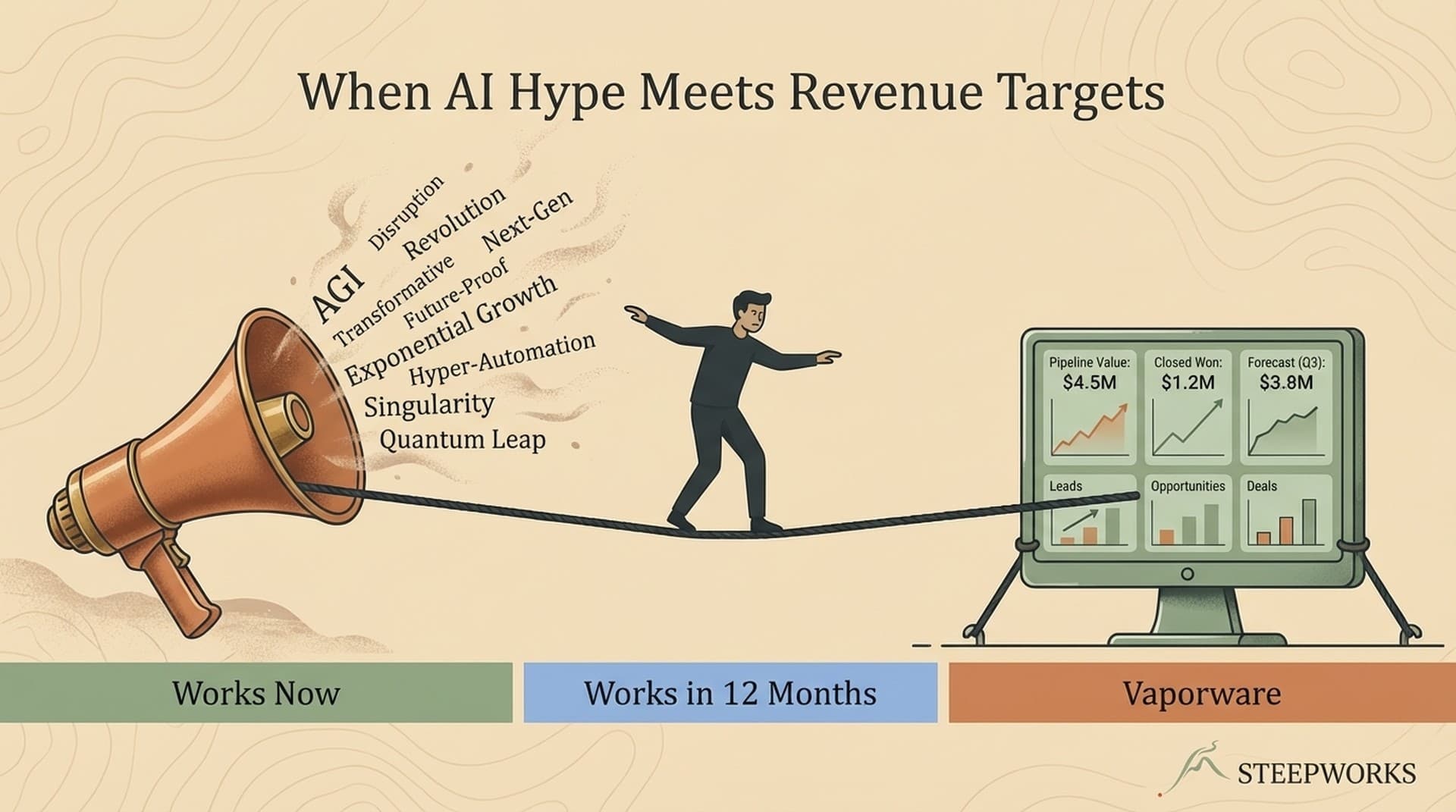
This isn't a "is AI real?" article. AI is real. I build with it every day. The question is which AI works for revenue teams now, which is 12-18 months from production-ready, and which is vaporware dressed up in a demo.
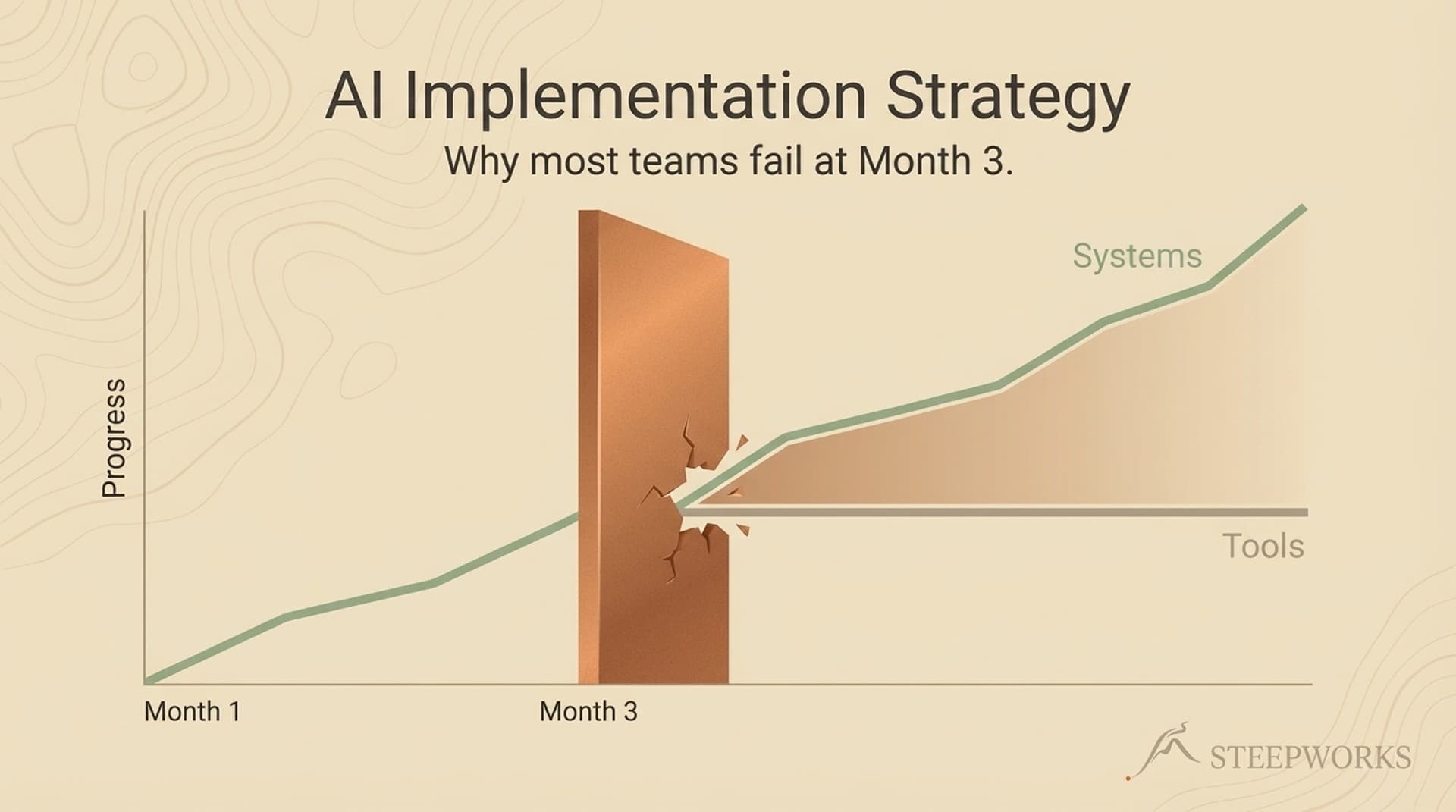
I wrote about why most AI implementations fail at Month 3. This extends that diagnosis to the vendor terrain. The same pattern -- excitement, friction, abandonment -- plays out not just inside your team but across the entire AI tooling market.
What Vendors Promise vs. What Ships
The demo-to-production gap follows predictable patterns. After evaluating, buying, and deploying AI tools for GTM since 2023, I've watched the same failure modes repeat enough to name them.
Pattern 1: The Impressive Demo. The tool works beautifully in the sales call. Demo data is clean, the use case is controlled, results are cherry-picked. In production, your data is messy, edge cases are everywhere, and accuracy drops from 90% to 60%. That 30-point gap is the distance between "this will change everything" and "my team stopped using it in week six."
Pattern 2: The Feature Announcement. "Coming in Q2" becomes Q3, then Q4, then "we're rethinking the approach." The roadmap features that drove your purchase decision never ship -- or ship so differently that your original use case no longer applies. A feature gets announced at a keynote, appears on a comparison chart during the sales cycle, and quietly disappears from the changelog.
Pattern 3: The "AI-Powered" Label. A rules-based system with an AI wrapper. The AI does 10% of the work; deterministic logic does 90%. You're paying an AI premium for a well-built automation. Don't get me wrong -- sometimes the automation is useful. But if I'm paying for AI, I expect the system to learn and improve. If it's a static ruleset, price it like one.
Pattern 4: The Integration Tax. The tool works in isolation, but connecting it to your stack takes 3x longer than promised, requires custom middleware, and breaks every time the vendor pushes an update. "Works with your CRM" means something different in a demo than in a production HubSpot instance with 47 custom properties and three years of data hygiene debt.
Deloitte's data: only 11% of organizations have AI agents in production, despite 38% piloting them. That 27-point drop between pilot and production is where these patterns live.
I'm not naming vendors because the patterns matter more than the names. If you've evaluated AI tools for more than six months, you've experienced at least two of these.
The 3-Month Failure Pattern
In the systems-over-tactics piece, I described how AI implementations follow a predictable curve: Week 1-4 excitement, Week 5-8 friction, Week 9-12 abandonment. That pattern maps to the entire vendor engagement lifecycle.
Month 1: Onboarding, excitement, "this is going to change everything." The vendor is responsive. Your team is curious. The internal champion has momentum.
Month 2: Integration problems surface. Edge cases appear -- the kind that didn't show up in the POC because POC data was cleaner than production. Your team starts building workarounds around the tool, the opposite of what it was supposed to accomplish.
Month 3: The tool is either embedded in a workflow or it's shelfware. By now, your team has decided with their behavior, whether or not they've told you.
BCG's data: only 5% of firms achieve AI value at scale. 60% report no material value. The 95% who don't get there mostly hit the wall between months 2 and 4.
If your AI tool hasn't contributed to a measurable revenue outcome by Month 3, the probability of it ever doing so drops sharply. Not because the tool is bad, but because your team has already built habits around the workaround. Changing those habits means fighting two forces of inertia instead of one.
What I got wrong: I fell for the "just give it more time" argument more than once. Twice, I kept paying past the three-month mark because the vendor convinced me the next release would fix the integration. Both times, I churned. Month 3 is a decision point, not a patience test. If the tool hasn't proven value by then, cut it and reallocate.
The Revenue-Lens Framework
After enough expensive lessons, I evaluate every AI tool against three questions. Not features. Not the demo. Three questions that cut through the pitch.
Question 1: Does this touch a revenue moment?
A "revenue moment" is any interaction that directly influences whether a deal moves forward: prospect research, meeting prep, follow-up, proposal, objection handling. If the tool doesn't touch one, it's an efficiency investment, not a revenue investment. Different budget, different ROI timeline, different conversation with your CFO.
Question 2: Can I measure the before/after within 30 days?
If I can't define what "better" looks like within 30 days of deployment, the tool is too abstract for my current maturity. It might require infrastructure I haven't built yet -- clean CRM data, integrated workflows, a team ready to adopt. The 30-day filter isn't a quality judgment. It's a readiness filter.
Question 3: Does it compound or reset?
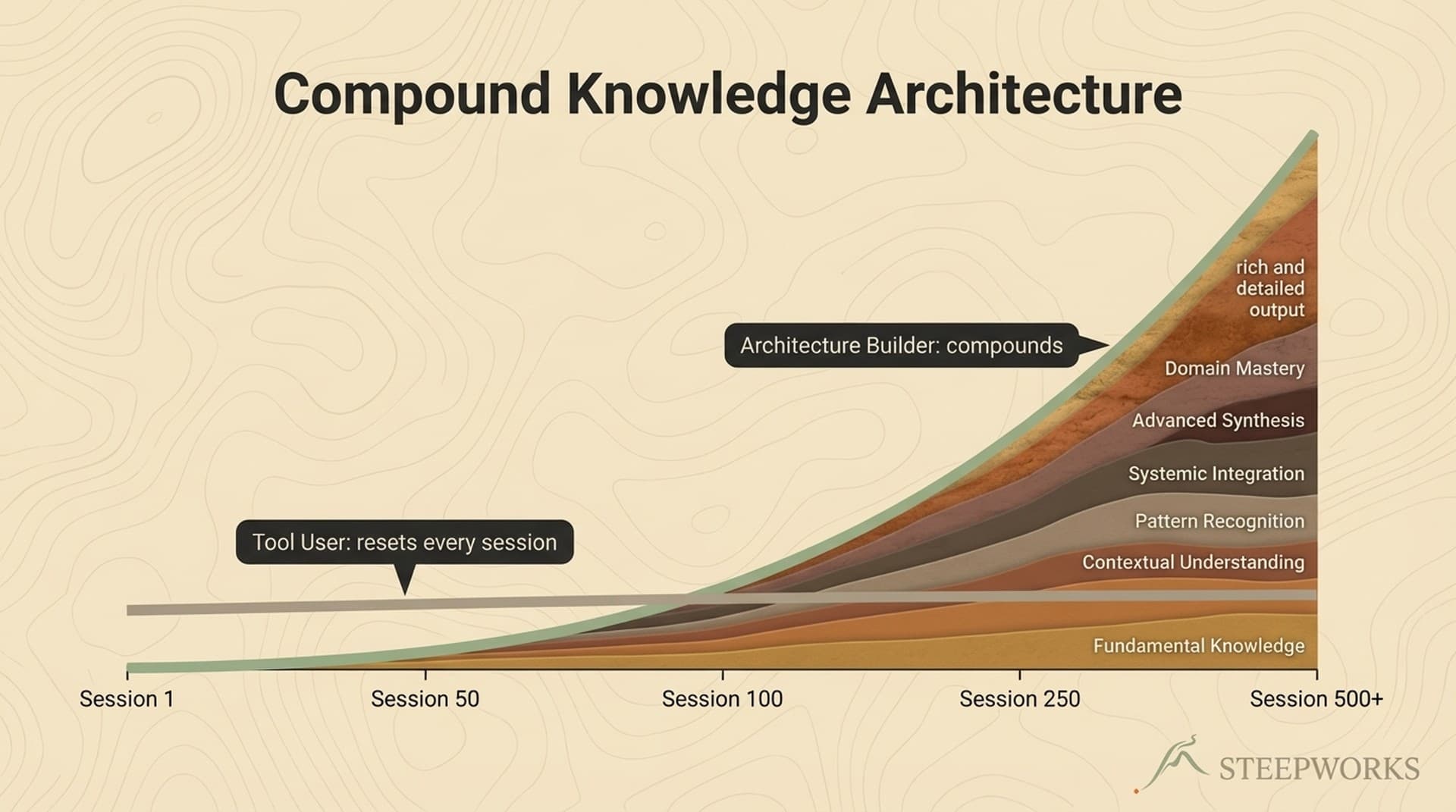
Does the tool learn from previous interactions, or does every session start from zero? A tool that compounds -- remembers context, improves with use, builds institutional knowledge -- has fundamentally different economics than one that resets. The compound tool gets more valuable over time. The reset tool stays flat.
I've built this into a formal evaluation: weighted scoring across seven dimensions, TCO calculations including integration cost, competitive comparison matrices. But the three questions are the fast filter. They eliminate roughly 70% of vendor pitches within 15 minutes -- not because most tools are bad, but because most don't yet solve a revenue problem at the maturity level of the teams buying them.
Forrester predicts enterprises will delay 25% of AI spend into 2027. The operators who get ahead aren't spending less. They're spending on tools that pass the three-question filter while competitors spread thin across tools that don't.
Where AI Genuinely Helps Revenue (Right Now)
The critique is only useful if I also name what's working. Here's what delivers measurable revenue impact -- not "has potential," but working in production. (See also: research prospect)
Prospect and account research. The most consistently valuable AI application in GTM right now. Synthesizing public data, earnings calls, 10-Ks, LinkedIn activity, and news mentions into a pre-call brief. 45 minutes of manual research compressed into minutes. I've written about the AI GTM stack I actually use -- research is where the ROI is clearest.
Meeting prep and follow-up. AI that ingests CRM notes, meeting transcripts, and deal context to generate prep docs and follow-up drafts. This is where the compound effect shows up most. Each meeting adds to the account knowledge base. By meeting three, the system retains more context than most reps remember -- prior objections, stakeholder preferences, competitive mentions, internal politics. (See also: hubspot integration)
I've built this as a production system. Before a first call, a workflow ingests the prospect's LinkedIn, company news, the last 10-K if public, and prior CRM notes. It synthesizes a one-page brief with business context, pain points mapped to our solution, and three conversation starters grounded in their situation. After the call, notes feed back into the account record. By the third meeting, the AI holds more deal context than most reps retain. Research alone saves 30-40 minutes per account -- measured over six months.
Content personalization at the individual level. Not "Dear {FirstName}" personalization. AI that reads a prospect's recent LinkedIn posts and adjusts messaging to reference their specific concerns. Response rates improve when the personalization is genuinely contextual -- when the message demonstrates understanding of the prospect's world rather than filling in a template variable.
Pipeline analysis and pattern detection. AI that identifies deal risk patterns across CRM data -- deals that went quiet, engagement scores dropping, champion title changes, multi-threading gaps. The human still makes the call. The AI surfaces patterns you'd miss across 50+ open deals. I run a 10-dimension risk scoring system that flags zombie deals, missing next steps, and champion departures. It doesn't replace judgment. It sharpens it.
What's NOT working yet: Fully autonomous outbound (too generic to pass a spam filter). AI-generated proposals without human review (structure helps, substance is thin). Autonomous deal negotiation (not close). Real-time conversational coaching (promising in demos, not reliable in production).
These are 12-18 months from production-ready for most teams. The vendors selling them aren't 12-18 months away from selling them -- they're selling now, with demos that make them look ready today.
For what I mean by specificity: I wrote about how to set up Claude Code for sales in 90 minutes. Not "AI can help sales" but "here's the tool, here's the setup, here's the workflow, here's what it produces."
The Vaporware Taxonomy
Not all "overhyped" is the same. I categorize AI tools into three types of "not yet," because each requires a different response. Using the wrong one -- buying when you should wait, waiting when you should buy with adjusted expectations -- is where most waste happens.
Category 1: Genuinely Not Ready.
The technology doesn't reliably work for the stated use case. Fully autonomous AI SDRs are the clearest example. The models can write emails, but they can't navigate a multi-touch outbound sequence with the judgment a human rep brings -- reading tone, adjusting cadence, knowing when to push and when to back off. The models improve every quarter. It's not there yet, and buying now means paying to beta test while your outbound suffers.
Response: Wait and monitor. Re-evaluate in 6-12 months. Don't pay to be the guinea pig unless you've budgeted for R&D.
Category 2: Ready but Oversold.
The technology works, but the vendor sets expectations production can't match. AI meeting note-takers are the clearest example. They're useful -- I use one. But they're sold as "never miss an insight again" when they capture 70-80% of what matters and still require human review. The tool is good. The expectation was wrong.
Intent data enrichment and lead scoring fall here too. The tools work and surface signals you'd miss manually. But "AI-powered intent signals" sounds like magic when the reality is probabilistic scoring that needs a human to interpret.
Response: Buy, but reset expectations before deployment. Tell your team what it does well and where they'll still fill gaps.
Category 3: Working but Invisible.
AI that delivers value but doesn't generate excitement because the value is boring. CRM deduplication. Contact data hygiene. Enrichment pipelines that keep your database current. These tools save hours and improve every downstream system because clean data makes everything else accurate.
Nobody writes a LinkedIn post about their enrichment pipeline. But this is where quiet, compounding AI value lives. If your CRM data is dirty, the fancy meeting prep AI produces garbage. If your contact records are stale, the personalization engine personalizes to someone who left six months ago.
Response: Buy and don't expect excitement. Budget for it like infrastructure. Measure it in error rates reduced and time saved.
The taxonomy matters because most AI frustration comes from treating all three the same -- waiting on tools that are ready, buying tools that aren't, and underinvesting in tools that work quietly.
What Revenue-Informed AI Strategy Sounds Like
The CEO asks "what's our AI strategy?" What they mean: "Are we falling behind, and is this helping us make money?" Two different questions. Answer them separately.
Are we falling behind?
For most teams: no. Deloitte says 11% have AI agents in production. Gartner says GenAI is in the Trough of Disillusionment. The pressure feels urgent because every keynote mentions AI. The competitive gap is smaller than the hype suggests. The teams that feel behind are comparing themselves to vendor demos, not their actual competitors.
Is AI helping us make money?
This is where the framework earns its keep. Report on specific revenue moments where AI is deployed, measurable before/after, and compound vs. reset.
Here's what that sounds like: "We use AI for prospect research and meeting prep. Research time per account dropped from 45 minutes to under 10. Prep quality improves because the system retains context -- by the third meeting, the AI surfaces prior objections, stakeholder context, and competitive mentions without anyone digging through notes. We haven't deployed AI for outbound sequencing because the technology isn't reliable yet. Re-evaluation trigger set for Q3."
That answer is honest, specific, and doesn't oversell. It positions you as someone who knows the terrain rather than someone parroting vendor talking points.
The CEO will respect "here's what works, here's what doesn't, here's what we're watching" far more than "we're implementing an AI transformation strategy across the GTM org." The first sounds like an operator. The second sounds like someone who read a blog post.
An Honest Assessment After 2.5 Years
After building AI-in-GTM systems across three companies -- buying tools, building workflows, shipping to production -- here's where I net out.
AI is real, and the hype is also real. Both true simultaneously. The technology works for specific, bounded use cases. The marketing is inflated for most. Holding both truths without collapsing into cynicism or credulity is the operator's job.
Revenue impact is concentrated, not distributed. AI doesn't improve everything by 10%. It improves a few things by 50-80% and does nothing measurable for most tasks. Prospect research, meeting prep, pipeline risk detection -- these are the concentration points. Vendors who promise even improvement across the entire GTM motion are selling a future that doesn't exist yet.
The compound effect takes longer than you think. The tools that deliver the most value after 12 months are rarely the ones that impressed in the demo. Boring, reliable tools that compound knowledge -- systems that remember context, improve with use, build institutional memory -- become indispensable. Flashy tools that reset every session impress in week one and get abandoned by month three.
The best AI strategy is a revenue strategy with AI in it. Not "what can AI do for us?" but "what revenue problems do we have, and does AI solve any of them better than the alternatives?" Start from the revenue problem. Work backward to the technology. Sometimes a well-built automation, a better process, or an additional headcount solves it faster.
What I'm betting on next 12 months: Contextual meeting prep that remembers every prior interaction with an account. I believe this will be the highest-ROI AI investment for revenue teams by Q4. I'm also watching multi-step workflow orchestration -- AI that runs research, enrichment, and outreach without manual handoffs. Not production-ready yet, but closer than the autonomous SDR crowd thinks.
What I'm ignoring: Fully autonomous outbound, AI-generated proposals without human review, any tool that promises to "replace" a revenue team member. 18-24 months from production-ready. The vendor pitches are 18-24 months ahead of the technology. I'd rather deploy resources on concentrated wins than spread thin chasing tools that aren't ready.
The hype cycle will keep cycling. Your quota doesn't care what Gartner says. Build from the revenue problem outward. Evaluate with the three-question framework. Give yourself permission to say "not yet." That's not falling behind. That's the discipline that compounds.